
TGUVFQ2001PE
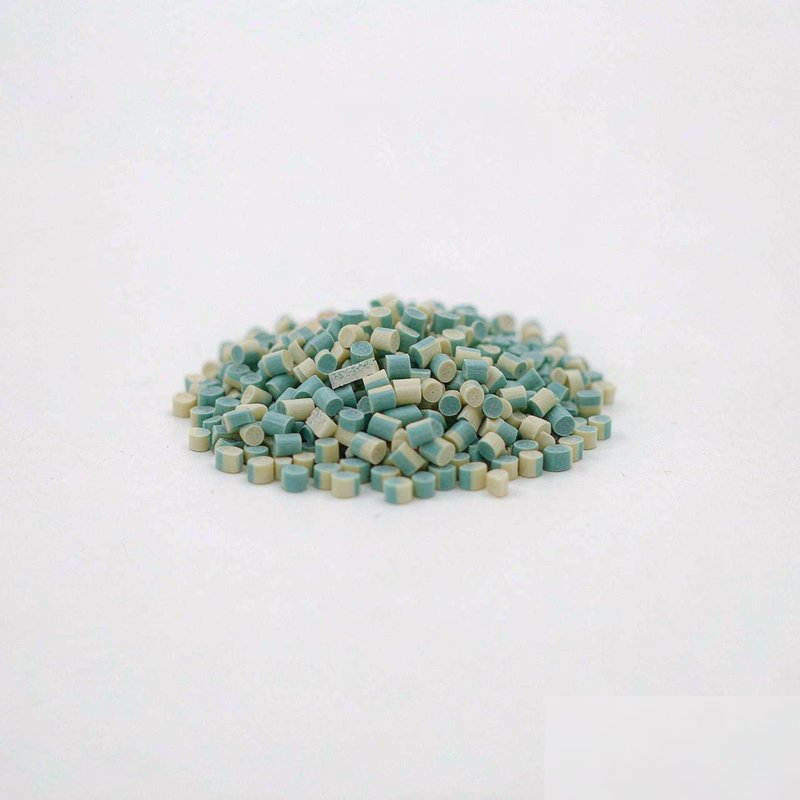
Functional masterbatch · TGUVFQ2001PE
designed to fulfill the requirement to protect the PE films against strong UV sunlight. It is particularly effective when used in thick long-life films, > 100 micron, and expected life-expectance 2-3 yrs
What it is
TGUVFQ2001PE is a functional masterbatch. A masterbatch pre-disperses the active ingredient in a carrier resin and delivers it as pellets. The line simply blends it in, with no powder handling and no local over-concentration from weighing error.
Technical data
| Product Name | TGUVFQ2001PE |
| Description | TiangangTM Masterbatch TGUVFQ2001PE is designed to fulfill the requirement to protect the PE films against strong UV sunlight. It is particularly effective when used in thick long-life films, > 100 micron, and expected life-expectance 2-3 yrs. |
| Dosage Recommendations | Usually 2% - 5% for greenhouse films (0.4 - 1% concentration of HALS), though exact dosage amount are affected by a number of factors, and should be determined by experiments. |
| Item | Percentage, % | Description | |
| 1. | Hindered Amine Light Stabilizer (HALS) | 20 | High molecular weight HALS |
| 2. | UV Absorber (UVA) | 5 | Effective UV absorber |
| 3. | Antioxidant (ATO) | 5 | Antioxidant providing protection during extrusion |
| 4. | Carrier | 70 | LLDPE resin |
| TOTAL | 100 |
Where it is used, and at what loading
The carrier decides which polymer the masterbatch can go into: PE carrier for PE, PET carrier for PET. The wrong carrier gives poor dispersion, interfacial defects or haze.
| Film and nonwoven | 2 – 5% |
|---|---|
| Moulding and extrusion | 2 – 4% |
| Based on active content | back-calculate from the target loading |
Figures above are typical industry ranges, not guaranteed values. The actual loading depends on wall thickness, design life and the other additives in the system, and should be established by a loading ladder on the real formulation.
On the line
Divide the target loading by the active content to get the let-down ratio: a 20% masterbatch used at a 0.3% target means 1.5% let-down. Dry-blend with the base resin; no extra compounding step is needed. Dry hygroscopic carriers before running. When switching grades on the same line, confirm dispersion and surface appearance on a small batch first.
Choosing between similar grades
Three things decide the choice for TGUVFQ2001PE: carrier-to-matrix match, active content, and application fit. PE-carrier masterbatch for thick greenhouse film, where the longer optical path makes the UV absorber's contribution more visible than in thin film.
How the whole film formulation fits together
One grade rarely tells the whole story. Greenhouse film is usually three-layer co-extrusion: the outer layer carries the UV package, the middle layer holds mechanical strength, the inner layer faces sulfur and chlorine. Mulch film is only 8–15 µm thick, so mechanical integrity and controlled degradation must be met at the same time. Nonwoven and shade net age for different reasons again. Tiangang has set out the ageing mechanisms, the choice between xenon and QUV testing, and a grade-by-grade table for all six covering categories in one document: anti-ageing solutions for agricultural covering materials.
Frequently asked questions
Masterbatch or powder — what is the real difference?
Three things: dispersion uniformity, dust, and weighing accuracy. Pre-dispersion puts the active at micron scale so thin parts do not show local defects; the line has no airborne powder; and blending a pellet ratio is far more accurate than weighing a trace of powder.
Why can the carrier not be swapped freely?
Carrier and matrix compatibility decides dispersion. A PE carrier in PP is tolerable; in PET it is not — the processing windows are too far apart and the carrier degrades first. We match the carrier to the matrix and show it in the grade code (MB6250PP20 is a PP carrier with 20% active).
How do I read the active content from the grade code?
From the numbers. MB570-20PET is 20% UV-570 in a PET carrier; MB6250PP20 is a PP carrier with 20% active. Divide the target loading by the active content to get the masterbatch let-down ratio.
The figures and guidance above follow Tiangang's published technical material and common industry practice. For a specific formulation, refer to the batch COA and the technical agreement between the parties.
Certifications
- National High-Tech Enterprise
- Vice Chairman Unit, China Plastics Processing Industry Association (CPPIA)
- Vice Chairman Unit, Agricultural Plastics Branch, China Agricultural Plastics Application Technology Society
- Member, Ageing Methods Subcommittee, National Technical Committee on Plastics (SAC/TC15/CS5)
- Member, Society of the Plastics Industry (SPI), USA
Recommended Products
Products
UV Absorbers
400-094-4362
- Tiangang elected Executive Deputy Director Unit of CPPIA Agricultural Film Committee
- Tiangang wins Leading Award at Beijing TV Innovation Institute finals
- Tiangang concludes CHINAPLAS 2023 on a high note
- First industry-academia-research base in Weishanzhuang Town lands at Tiangang
- Tiangang-Tinaco BUCT scholarship award ceremony 2021-2022