
Why Do We Need Light Stabilizers?
Sunlight and some forms of artificial irradiation can adversely affect the service life of polymer materials. This adverse effect is typically manifested as fading, surface cracking, loss of gloss, and a series of changes such as declines in tensile strength and elongation at break—i.e., mechanical-performance degradation. This is because UV radiation can cause scission of chemical bonds in polymers, triggering severe photo-degradation reactions and leading to loss of the material's physical properties. Tiangang is committed to providing customers with complete light-stabilization solutions and a range of UV-stabilizer products; for polyolefins, various engineering plastics, and coatings, typically only a few parts per thousand need to be added to effectively mitigate photo-chemical reactions and greatly extend the service life of polymer materials.
Light-stabilizing additives come in many types; briefly, they can be divided into two major categories: UV absorbers (UV Absorber, UVA) and hindered amine light stabilizers (Hindered Amine Light Stabilizer, HALS).
UV Absorbers (UVA)
UV absorbers avoid material damage by absorbing part of the ultraviolet light striking the polymer material and converting the harmful UV radiation into harmless heat energy; this is one of the commonly used means of preventing photo-aging in many engineering plastics and coatings. To achieve this effect, UV absorbers usually need to form a certain concentration on the material surface and have a certain thickness to work well. In many applications, the combined use of UV absorbers and hindered amine light stabilizers can significantly improve light-stabilizing performance.
Hindered Amine Light Stabilizers (HALS)
Hindered amine light stabilizers do not absorb UV light, yet they are highly effective UV stabilizers. These additives all contain a hindered active amine group that effectively suppresses photo-degradation chemical reactions by capturing the free radicals produced in the photo-degradation chain reaction. These light stabilizers can achieve excellent anti-aging effects at low concentrations, a high performance that partly stems from the cyclic regeneration capability of nitroxyl radicals in their molecular structure. Because they do not depend on product thickness to take effect, HALS can provide more prominent protection to the surfaces of both thin and thick articles. Many hindered amine light stabilizers also serve as heat stabilizers during long-term use from room temperature to relatively high temperatures, significantly improving the long-term heat stability (LTHS) of articles. Moreover, in many demanding chemical-fiber industries—such as polypropylene, spandex, and nylon fibers—hindered amine light stabilizers are also used to replace phenolic antioxidants as the primary antioxidant in fiber polymerization production.
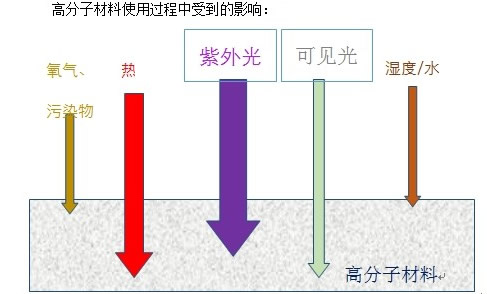
Light-stabilizing additives come in many types; briefly, they can be divided into two major categories: UV absorbers (UV Absorber, UVA) and hindered amine light stabilizers (Hindered Amine Light Stabilizer, HALS).
UV Absorbers (UVA)
UV absorbers avoid material damage by absorbing part of the ultraviolet light striking the polymer material and converting the harmful UV radiation into harmless heat energy; this is one of the commonly used means of preventing photo-aging in many engineering plastics and coatings. To achieve this effect, UV absorbers usually need to form a certain concentration on the material surface and have a certain thickness to work well. In many applications, the combined use of UV absorbers and hindered amine light stabilizers can significantly improve light-stabilizing performance.
Hindered Amine Light Stabilizers (HALS)
Hindered amine light stabilizers do not absorb UV light, yet they are highly effective UV stabilizers. These additives all contain a hindered active amine group that effectively suppresses photo-degradation chemical reactions by capturing the free radicals produced in the photo-degradation chain reaction. These light stabilizers can achieve excellent anti-aging effects at low concentrations, a high performance that partly stems from the cyclic regeneration capability of nitroxyl radicals in their molecular structure. Because they do not depend on product thickness to take effect, HALS can provide more prominent protection to the surfaces of both thin and thick articles. Many hindered amine light stabilizers also serve as heat stabilizers during long-term use from room temperature to relatively high temperatures, significantly improving the long-term heat stability (LTHS) of articles. Moreover, in many demanding chemical-fiber industries—such as polypropylene, spandex, and nylon fibers—hindered amine light stabilizers are also used to replace phenolic antioxidants as the primary antioxidant in fiber polymerization production.
Technical reviewTiangang Technical CenterVersion2014-03-18
Specifications and application notes on this page are compiled from Tiangang's published technical data. Actual values are governed by the COA shipped with each lot and the technical agreement confirmed by both parties.
- None
- None
Certifications
- National High-Tech Enterprise
- Vice Chairman Unit, China Plastics Processing Industry Association (CPPIA)
- Vice Chairman Unit, Agricultural Plastics Branch, China Agricultural Plastics Application Technology Society
- Member, Ageing Methods Subcommittee, National Technical Committee on Plastics (SAC/TC15/CS5)
- Member, Society of the Plastics Industry (SPI), USA
Recommended Products
Products
UV Absorbers
400-094-4362
- Tiangang elected Executive Deputy Director Unit of CPPIA Agricultural Film Committee
- Tiangang wins Leading Award at Beijing TV Innovation Institute finals
- Tiangang concludes CHINAPLAS 2023 on a high note
- First industry-academia-research base in Weishanzhuang Town lands at Tiangang
- Tiangang-Tinaco BUCT scholarship award ceremony 2021-2022
Online Inquiry
Online inquiry
Share the substrate, processing conditions and target service life to save a round of back-and-forth.
Start an inquiry 400-094-4362