
Tiangang® AO-1076
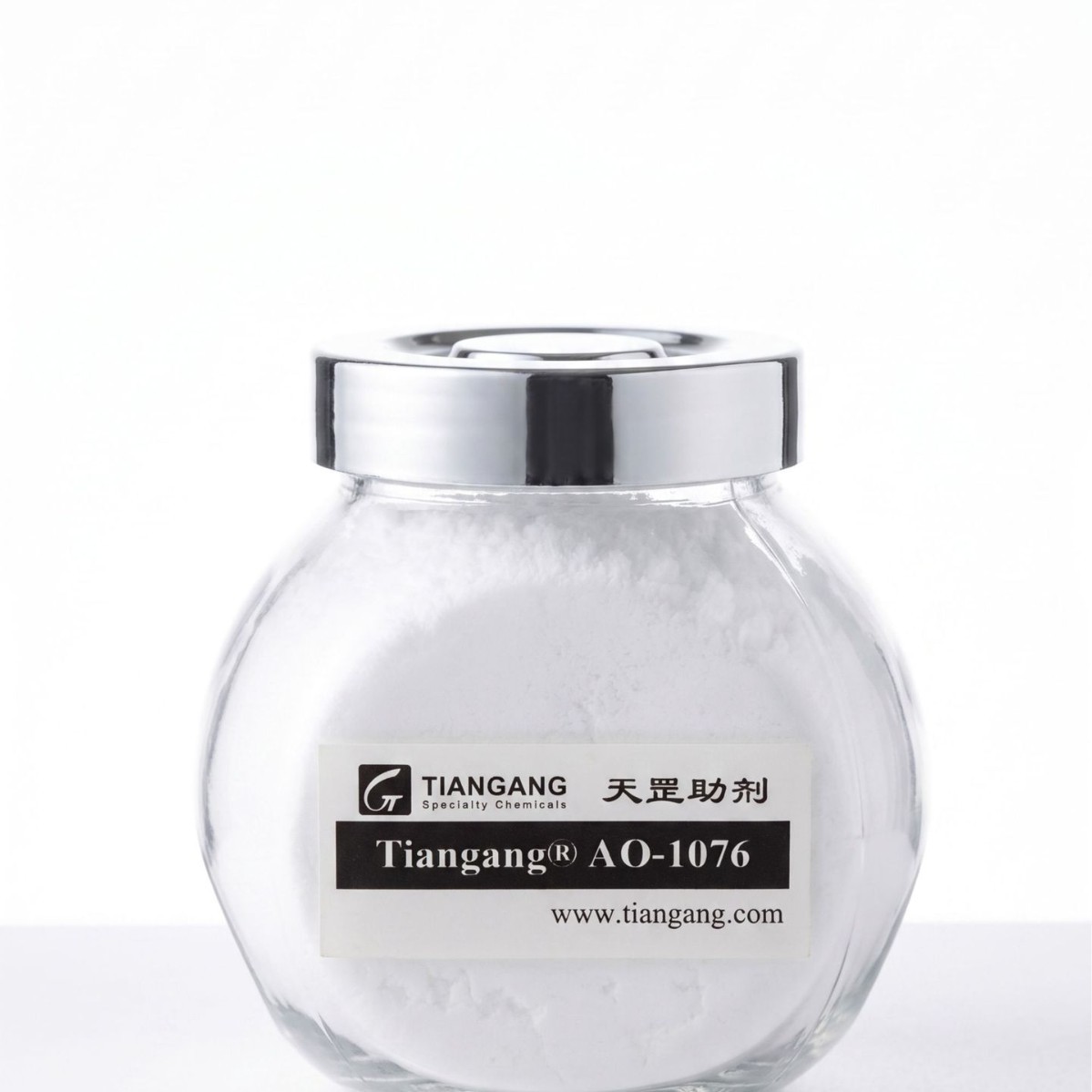
Antioxidant · AO-1076
Tiangang® AO-1076 is a high-efficiency hindered phenolic antioxidant that prevents oxidative degradation of polymers caused by heat and oxygen during processing and in service
In one sentence: A monofunctional hindered-phenol primary antioxidant with low volatility and low colour contribution, for long-term thermo-oxidative stabilisation of polyolefins and coatings.
- Molecular weight: 531 g/mol (source: spec table on this page)
- Melting point: 50 – 55 °C (source: spec table on this page)
- Bulk density: 530 – 630 g/L (source: spec table on this page)
- Packaging: 25 kg per unit (source: packaging note on this page)
What it is
Tiangang® AO-1076 is a antioxidant. Antioxidants come in two roles. Primary antioxidants (hindered phenols) trap radicals and stop the chain; secondary antioxidants (phosphites) decompose hydroperoxides. Used together they cover both processing and service life. Product identifiers: chemical name Octadecyl-3-(3,5-di-tert.butyl-4-hydroxyphenyl)-propionate; CAS 2082-79-3; molecular weight 531; melting point 50 – 55.
Technical data
| Appearance | White powder |
|---|---|
| Molecular weight | 531 |
| Melting point (°C) | 50 - 55 |
| Bulk density (g/L) | 530 - 630 |
| Acetone | 19 |
|---|---|
| Chloroform | 57 |
| Cyclohexane | 40 |
| Ethanol | 1.5 |
| Ethyl acetate | 38 |
| Toluene | 50 |
| Water | <0.01 |
Molecular weight around 531 — mid-range: a workable balance between diffusion speed and retention.Melting point 50 – 55 °C — the processing window needs to reach above it for uniform dispersion.
Where it is used, and at what loading
Polyolefins are the main field, followed by polyacetal, polyamide, polyester, PVC, polystyrene and elastomers. The higher the melt temperature and the longer the residence time, the more the system needs.
| Primary (hindered phenol) | 0.05 – 0.3% |
|---|---|
| Secondary (phosphite) | 0.05 – 0.2% |
| One-pack blends | 0.1 – 0.5% |
Figures above are typical industry ranges, not guaranteed values. The actual loading depends on wall thickness, design life and the other additives in the system, and should be established by a loading ladder on the real formulation.
Choosing between similar grades
Three things decide the choice for AO-1076: molecular weight and volatility, basicity, and compatibility with the other components in the system. Monofunctional hindered phenol, lower MW and better compatibility than 1010, at some cost in extraction resistance.
Frequently asked questions
Do primary and secondary antioxidants have to be used together?
In most cases yes. The primary handles radicals, the secondary handles hydroperoxides; using only one leaves the other degradation path open. Blends such as B215, B225 and B277 pre-mix the two, which removes weighing error at the line.
Why does low initial colour matter?
Some phenolic antioxidants form quinoid structures during processing and yellow the part. Fibre, film and light-coloured articles are most sensitive. Low-colour grades suppress that side reaction at the source.
Can antioxidants and light stabilizers interfere?
Yes, mainly through acid-base conflict. Acidic components (some phosphites, halogenated flame retardants) deactivate highly basic HALS. We look at both sides of the balance and switch to a low-basicity HALS where needed.
The figures and guidance above follow Tiangang's published technical material and common industry practice. For a specific formulation, refer to the batch COA and the technical agreement between the parties.
Certifications
- National High-Tech Enterprise
- Vice Chairman Unit, China Plastics Processing Industry Association (CPPIA)
- Vice Chairman Unit, Agricultural Plastics Branch, China Agricultural Plastics Application Technology Society
- Member, Ageing Methods Subcommittee, National Technical Committee on Plastics (SAC/TC15/CS5)
- Member, Society of the Plastics Industry (SPI), USA
Recommended Products
Products
UV Absorbers
400-094-4362
- Tiangang elected Executive Deputy Director Unit of CPPIA Agricultural Film Committee
- Tiangang wins Leading Award at Beijing TV Innovation Institute finals
- Tiangang concludes CHINAPLAS 2023 on a high note
- First industry-academia-research base in Weishanzhuang Town lands at Tiangang
- Tiangang-Tinaco BUCT scholarship award ceremony 2021-2022