
Industry Insights and Trend Analysis
Industry Insights and Trend Analysis
This page is not an industry encyclopedia. What it sets out is Tiangang's judgment on three lines: demand, regulation and technology, and how that judgment has changed Tiangang's product portfolio and the direction of its R&D investment.
Tiangang works to one principle in product planning: every external change must be traceable to a concrete product action. If it cannot be traced, it is only information; if it can, it is strategy. This page presents Tiangang's judgments together with the corresponding actions.
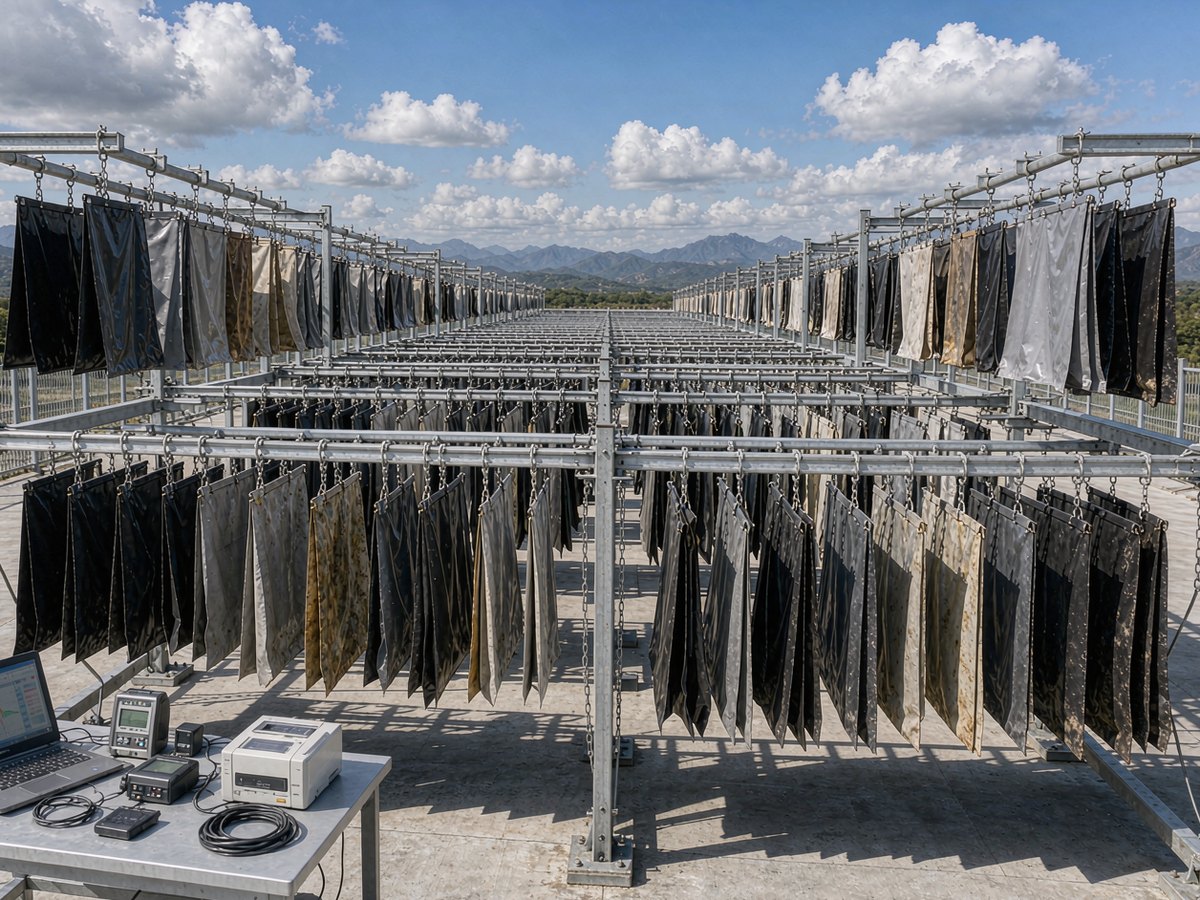
Outdoor exposure is the only verification method that accelerated testing cannot fully replace - the complexity of real climate always exceeds any laboratory
Market Size: Global and China, 2024 vs 2025E
China produced 18.99 ×10⁴ t of light stabilisers in 2024 and 20.19 ×10⁴ t in 2025E, the largest base worldwide.
| Indicator | 2024 | 2025E |
|---|---|---|
| China light-stabiliser output | 18.99 ×10⁴ t | 20.19 ×10⁴ t |
| China light-stabiliser demand | 16.24 ×10⁴ t | 17.30 ×10⁴ t |
| Net exports | 2.75 ×10⁴ t | 2.89 ×10⁴ t |
| China market value | CNY 79.25 ×10⁸ | CNY 81.48 ×10⁸ |
| of which plastics | CNY 41.63 ×10⁸ | — |
| of which chemical fibre | CNY 18.25 ×10⁸ | — |
| of which coatings | CNY 14.44 ×10⁸ | — |
| Global market value | CNY 33.63 ×10⁸ | CNY 34.73 ×10⁸ |
China is a net exporter of light stabilisers, and the export share keeps rising.
1. How Tiangang sees the current competitive landscapeMarket Landscape & Tiangang's Position
China is not only the world's largest producer of plastic products but also the most important production and trading base for light stabilizers - more than half of the global light stabilizer market is in China. Tiangang sees this scale clearly, but does not treat it as a moat.
| Indicator | 2024 | 2025 (forecast) | Note |
|---|---|---|---|
| China light stabilizer output | 189,900 tonnes | 201,900 tonnes | the world's largest production and trading base |
| China light stabilizer demand | 162,400 tonnes | 173,000 tonnes | |
| Net exports | 27,500 tonnes | 28,900 tonnes | China is a net exporter of light stabilizers |
| China light stabilizer market size | RMB 7.925 billion | RMB 8.148 billion | of which plastics RMB 4.163 billion, chemical fibers RMB 1.825 billion and coatings RMB 1.444 billion |
| Global light stabilizer market size | USD 3.363 billion | USD 3.473 billion | Asia accounts for 55.07% |
This landscape has one direct implication, and it is why Tiangang has not treated capacity as its main battlefield for more than three decades: "Being number one in capacity" is not a barrier. Large-scale domestic HALS capacity has long since stopped being a scarce resource, and the center of competition is shifting from capacity to technology and service. Tiangang keeps its R&D investment pointed at testing capability, proprietary technology and application technical service - none of the three can be caught up with by adding capacity.
Data source and basis: the table above is drawn from public research including Zhiyan Consulting's "Research on Development Trends of China's Light Stabilizer Industry"; the 2025 figures are that institution's forecast basis.When Tiangang provides market analysis it states the data source and statistical basis, does not stitch together figures across different bases, and does not cite second-hand numbers of doubtful origin.
2. Three structural changes Tiangang has locked ontoThree Shifts & Tiangang's Response
The EU PPWR ((EU) 2025/40) took effect in February 2025.
Change 1 | Service life stretching from 5 years to 25 years, and Tiangang bets its R&D on "long-term" performance
| Downstream sector | Typical design life | Core requirement for additives | Tiangang's response |
|---|---|---|---|
| Photovoltaics | Modules: 25-30 years | Effective throughout encapsulant film, backsheet, cable and sealant; low volatility and low migration, with no blooming that contaminates the silicon wafer; no synergistic acceleration of degradation with acetic acid released from EVA | HS-950, for floating PV on water, extending service life from 3-5 years to 10-20 years |
| Outdoor energy storage | Enclosures: 25 years | Four overlapping stresses: outdoor UV + high humidity + flame retardancy (UL94 V-0) + thermal shock | FR-810A + XT-8 combination |
| Wire and cable | 20-30 years | Sulfur and chlorine resistance, long-term outdoor installation, low migration (to avoid contaminating precision electronic components) | XT-8 (sulfur resistance 3000-7000 ppm, chlorine resistance ≤ 850 ppm) |
| Artificial turf | Above 10 years | Combined attack from infill materials and sodium hypochlorite bleach, acid rain, and acid release from filled rubber | T-68 / T-66 / T-69 compound package for agricultural film and turf service |
| Agricultural film | 1-3 years (PO film can be replaced every 2-3 years) | Resistance to blooming (chalking), no conflict with anti-fogging agents, and long-term effectiveness in high-humidity, low-temperature environments | HS-362 high molecular weight polymeric grade + MB0607 masterbatching |
| Automotive modified parts | 10-15 years | SAE J2527 cycles plus 95-105°C cabin temperatures; dual constraints of color difference and VOC odor; IATF 16949 system certification mandatory | T-70 / T-78 / T-81 (50%±2.5% concentration, MFI > 10) |
| Recycled products | Matched to the original part | Stabilizer system redesigned for 2-3 thermal histories, resisting consumption by acid groups and impurities | A standing work item for Tiangang's application technology team; virgin formulations are not copied across |
What longer service life demands is not "more additive", it is a completely different system for evaluating additives. Short-life products are judged on "initial performance"; long-life products are judged on the retention curve of performance over time - and the latter is precisely what is missing from most additive marketing today. The reason Tiangang's XT-8 greenhouse trial runs to 38 months rather than just 500 hours is to let customers see that retention curve.
Change 2 | A rising share of exports, and Tiangang turns compliance into a product capability
China's plastic product exports reached USD 106.09 billion in 2024 with a trade surplus of USD 88.29 billion, 9% of the national merchandise trade surplus. Once an export orientation is established, compliance is no longer "supplementary paperwork at customs", it is the first filter at grade selection. Tiangang has written this into its own product planning constraints - not because compliance is fashionable, but because export customers are stopped at exactly this gate.
| Restricted substance | Regulatory status | Tiangang's response |
|---|---|---|
| UV-328 | Annex to the POPs Regulation; limit 1 mg/kg (0.0001%), enforced from 2025-02-26 | Tiangang does not promote UV-326/328 as headline grades. The recommended route is low-basicity NOR (XT-8 / HS-112) plus a compounded anti-aging package, which does not depend on restricted grades in the first place |
| Methoxychlor | Annex to the POPs Regulation; limit 0.01 mg/kg | As above, avoided |
| UV-320 / UV-327 / UV-350 | SVHC Authorisation List; unauthorized use in the EU prohibited since 2023-11-27 | In technical exchanges Tiangang proactively flags the EU risk of these four grades to customers and offers substitution routes via HS-962 / HS-791 / HS-625 |
| UV-326 / UV-329 | SVHC Candidate List; newly added on 2024-01-23 | The four most common benzotriazole grades in the industry have all entered EU restricted lists - this is not a bonus point, it is a threshold |
| Tetrabromobisphenol A (TBBPA) | REACH Annex XVII ((EU) 2025/1731); applicable from 2025-09-01 | FR-810A, as a halogen-free polymeric flame retardant, avoids the brominated route by design |
| All PFAS | ECHA restriction proposal covering 22 industries; comments due before the end of 2026 | Tiangang's fluorine-free route: NOR light stabilizers + polymeric halogen-free flame retardants, containing no fluorinated structures |
Change 3 | Recyclate moves from "optional" to "mandatory", and Tiangang reformulates rather than copies
setting mandatory minimum recycled content for plastic packaging: 30% for single-use plastic beverage bottles and 35% for other plastic packaging by 2030, rising to 65% respectively by 2040 - the only enacted mandatory recycled-content regulation in the world.
China's direction is equally clear: the 14th Five-Year Plan Action Plan for Plastic Pollution Control requires an 85% agricultural film recovery rate by 2025; the 15th Five-Year Plan for Circular Economy Development targets 510 million tonnes of annual recycled utilization of major renewable resources by 2030; and the Action Plan for Promoting the Application of Recycled Materials sets annual recycled plastics output above 19.5 million tonnes by 2030.Tiangang listed the design of stabilizer systems for recycled feedstock as a standing work item for its application technology team back in 2025, waiting for this market.
For the additive industry this is a certain incremental market, but the threshold is not low. The stabilizer system for recyclate must be redesigned; virgin formulations cannot be carried over.Tiangang is clear-eyed about the threshold: whether the antioxidant and light-stabilizer phases can be rebalanced for recycled feedstock decides whether this market is an opportunity or a trap for Tiangang.
| Four "debts" carried by recyclate | Tiangang's response |
|---|---|
| Molecular weight has already dropped - recycling passes the material through 2-3 high-temperature histories (shear degradation): chains shorten and the antioxidant reserve falls | Rebalance the antioxidant phase: the level must exceed that of virgin material and cover a wider molecular weight distribution |
| Residual acidic oxides - acidic products generated during thermal history keep consuming HALS | Select the right basic or low-basicity balance for residual acid groups, favoring high molecular weight grades (XT-8, HS-362) |
| Impurities and pigment residues - cross-contamination introduces uncertain catalytic degradation pathways | Masterbatching is almost mandatory: recyclate carries more impurities and is harder to disperse |
| Odor - degradation products bring odors, a particular sensitivity for automotive and food-contact applications | Run a same-condition comparison against the customer's virgin formulation at the accelerated verification stage, tracking ΔE and mechanical retention |
China exported USD 1,060.9 ×10⁸ of plastic products in 2024 with a surplus of USD 882.9 ×10⁸, 9% of the national goods-trade surplus. Policy has moved in the same direction: the 15th Five-Year Plan for the circular economy targets an annual recycled-resource volume of 5.1 ×10⁸ t by 2030, and the recycled-materials action plan targets more than 1,950 ×10⁴ t of recycled plastics a year by 2030. HS-950, used in floating HDPE bodies for water-borne PV, shows what that means in practice: service life moves from the industry-typical 3-5 years to 10-20 years.
3. Four technology mainlines Tiangang has identifiedFour Technology Tracks & Tiangang's Products
Mn > 2000; the 10% weight-loss onset is above 350°C.
These four mainlines are not industry forecasts; they are the actual basis on which Tiangang schedules R&D. Each has corresponding Tiangang products, and none of them is a general-purpose grade.
Mainline 1 | NOR replacing conventional N-H types - Tiangang's XT-8 and HS-112
N-alkoxy hindered amines (NOR-HALS) have substantially lower basicity than conventional N-H types and sit in a higher oxidation state, so they work without a secondary regeneration cycle, and therefore perform markedly better in acidic, flame-retardant and coating systems. This is the evolution direction Tiangang judges most certain.
The quantitative comparison makes the point: in flame-retardant systems, in the same formulation, NOR plus flame retardant withstands about 4,000 hours (ASTM G26 spray), while a conventional FR/HALS system fails at about 800 hours. For products that must satisfy flame retardancy and outdoor weathering at the same time - outdoor storage enclosures, components around battery packs, cable jackets - this gap is the difference between pass and fail.
Tiangang's two key products on this mainline:XT-8, a high molecular weight NOR with a proprietary CAS structure, combining low basicity and low migration; HS-112, a low molecular weight liquid NOR whose liquid form eases processing and dispersion, used in complex formulations that coexist with acidic systems.
Mainline 2 | Polymerization and high molecular weight - Tiangang's HS-362 / HS-962 / HS-625
The technical limitation of conventional low molecular weight HALS is very clear: low molecular weight leads to easy migration, volatility and extraction, and anti-aging performance decays rapidly. The industry-recognized solution is to bond it to larger molecules and raise molecular weight. Tiangang has three proprietary grades on this mainline:
Tiangang's own IP product. High molecular weight reduces migration tendency and is the foundational solution to the "no blooming" requirement. In recyclate and long-term outdoor service it is the base of the entire stabilizer system.
High-temperature processing stability means it does not decompose first during processing and is carried through intact into the final part - a key constraint for modified pellets processed at high temperature.
Designed for extraction resistance in polymers, and winner of a provincial/ministerial-level Science and Technology Progress Award. Suited to film and media-contact scenarios sensitive to extraction. The value of the award is that it is third-party recognition of "extraction resistance" as a property.
Mainline 3 | Antioxidant compounding and high molecular weight - Tiangang's scenario-specific compound packages
Combining a primary and a secondary antioxidant is the standard formulation: a phenolic primary antioxidant (AO-1010 or AO-1076) plus a phosphite secondary antioxidant (AO-168), typically at a mass ratio of 1:1 to 3. Mechanistically the primary antioxidant cuts the oxidation chain while the secondary decomposes hydroperoxides and chelates metal ions; neither can be omitted.What Tiangang sets out to solve on this mainline is not "how to compound" but "how to fix the compound to the service condition" - which is why Tiangang does not make generic pre-blended packages, but scenario-specific compound packages.
On this mainline Tiangang does not make generic pre-blended packages, but scenario-specific compound packages tailored to downstream service conditions: agricultural film and turf applications use T-68 / T-66 / T-69; automotive modified parts use T-70 / T-78 / T-81, at 50%±2.5% concentration and MFI > 10, meeting IATF 16949 system requirements.
Mainline 4 | "Low acidification" of the flame retardant itself - Tiangang's FR-810A
This mainline only became clear in the last two years or so. The industry's earlier approach was to sidestep acidity at the formulation level (switch to low-basicity HALS, add acid scavengers); now the direction is reversing: make the flame retardant itself less acidic.
A domestic patented route uses a calcium oxide plus ammonium aluminium sulfate weak-alkali buffer system to bring the flame-retardant system to pH 6.5-7, compounded with a specific HALS level. The patent's inventors state explicitly that commercial dialkylphosphinic acid aluminium salt flame retardants significantly reduce the oxygen barrier performance of polyamide composites, accelerate internal oxidation, shorten service life, and corrode rubber in contact with the material.
Tiangang's FR-810A follows this route, and goes further - based on the international NOP™ patent, it is a polymeric halogen-free flame retardant combining flame retardancy, light stabilization and thermal stabilization in one product, so the flame-retardant system no longer emits acidic by-products and consumption of HALS is eliminated at the source rather than compensated downstream.
4. How Tiangang suggests customers evaluate suppliersHow Tiangang Thinks Suppliers Should Be Evaluated
The ranking below is Tiangang's judgment based on its own project experience, not the result of a published quantitative survey. Tiangang sets it out in the hope that when customers evaluate suppliers they will focus on the factors that genuinely determine long-term performance.
| Rank | Factor | Why it ranks here |
|---|---|---|
| 1 | Formulation synergy and application technical service capability | Tiangang's technical team asks about resin type, processing temperature, part thickness and end-use service conditions at the very first exchange, then gives a compounding recommendation - rather than quoting a loading straight away. This is Tiangang's first test of whether a supplier has real capability |
| 2 | Ability to handle difficult service conditions | Coexistence with flame retardancy, acid rain resistance, sulfur and chlorine resistance, extraction resistance - customers ask directly "can it last ten years". Tiangang's answer is to ask first "which metrics count as conforming after ten years" |
| 3 | Batch consistency and supply reliability | Tiangang's three bases (Beijing 100 mu / 6.7 ha, Gu'an 150 mu / 10 ha, Cangzhou 300 mu / 20 ha) with DCS automated control and ISO 9001 certification exist so that customers never have to re-validate when a batch changes |
| 4 | Compliance and the export passport | Under the POPs 1 mg/kg limit, a supplier that cannot provide a compliance declaration is out. Tiangang's CNAS reports are the hardest-edged answer on this item |
| 5 | Price | Tiangang ranks it low, and it is moving down fast - the mid and low end is already a price war, and that is not where Tiangang competes |
| 6 | Brand and international endorsement | Relatively secondary, but not omissible as the "entry ticket" in supplier audits. Tiangang® series products are exported to more than 20 countries and regions |
5. Five statements Tiangang corrects most often in technical exchangesFive Misconceptions Tiangang Corrects
Recyclate has been through 2-3 thermal histories.
These five are the questions Tiangang is asked most often at customer sites. None of them is the customer's fault; they are the blurry zones in industry marketing. Tiangang's technical team has to explain them every time, so they are written down here.
Statement 1: "1,000 hours of xenon-arc = 5 years outdoors"
This conversion has no universal factor in the industry. Xenon-arc testing is an accelerated simulation test, suitable only for side-by-side relative comparison; it cannot precisely replicate every environmental factor of real outdoor exposure. The same duration ages plastics, coatings and rubber differently, and year-to-year variation in natural exposure can exceed ±30%. Writing "XX hours = X years outdoors" directly in a test report undermines the report's validity. Tiangang's practice: run accelerated tests to standards such as GB/T 16422.2-2022 (identical to ISO 4892-2:2013) and ASTM G155-21, while using measured data from the Beijing and Guangzhou outdoor exposure sites to establish the correlation, and combine the two to reach conclusions.
Statement 2: "GB/T 23987 is the plastics weathering standard"
The GB/T 23987 series is paints and varnishes (coatings) xenon-arc standard, not a plastics standard. The corresponding Chinese national standard for plastics is the GB/T 16422 series (GB/T 16422.2-2022 is identical to ISO 4892-2:2013); automotive non-metallic parts are additionally covered by GB/T 32088-2015 (referencing SAE J2527). Choose the wrong standard and the test conclusion is meaningless. Tiangang confirms this before a customer places a testing order, so that tens of thousands of yuan in testing fees are not wasted.
Statement 3: "flame retardancy and weatherability are either/or"
This is a widely accepted misconception. Making the flame retardant itself low-acid (FR-810A), or switching to a NOR-type light stabilizer (XT-8), both work by resolving the opposition at the source rather than trading off in the middle. Tiangang's FR-810A + XT-8 combination is the proof of this route: 4,000 hours versus 800 hours for a conventional system in the same formulation.
Statement 4: "the more additive, the safer"
Past the compatibility threshold, adding more additive instead triggers blooming (chalking), haze, mechanical degradation and even stress cracking. Once film products are thinned, this window is especially narrow. Tiangang's answer is not more additive, but two things: high molecular weight (HS-362 / HS-625 / HS-962) to reduce migration, and masterbatching (MB0607 / TGUVFQ2001PE / MB6250 / MB6251) to improve dispersion.
Statement 5: "recyclate can use the virgin formulation as-is"
molecular weight has dropped, and residual acidic oxides and impurities keep consuming HALS. Copying the virgin formulation is a common cause of early cracking in recycled parts. Tiangang's approach is to rebalance the ratio of antioxidant and light-stabilizer phases, and to list this work as a standing work item for the application technology team.
Come to us with your specific service conditions
If you have a defined failure symptom - blooming, yellowing, chalking, discoloration of flame-retardant parts, life falling short - give Tiangang's technical team the resin, processing conditions and service environment; we run failure diagnosis for you first and discuss solutions after.
Go to the technical challenges sectionCertifications
- National High-Tech Enterprise
- Vice Chairman Unit, China Plastics Processing Industry Association (CPPIA)
- Vice Chairman Unit, Agricultural Plastics Branch, China Agricultural Plastics Application Technology Society
- Member, Ageing Methods Subcommittee, National Technical Committee on Plastics (SAC/TC15/CS5)
- Member, Society of the Plastics Industry (SPI), USA
Recommended Products
Products
UV Absorbers
400-094-4362
- Tiangang elected Executive Deputy Director Unit of CPPIA Agricultural Film Committee
- Tiangang wins Leading Award at Beijing TV Innovation Institute finals
- Tiangang concludes CHINAPLAS 2023 on a high note
- First industry-academia-research base in Weishanzhuang Town lands at Tiangang
- Tiangang-Tinaco BUCT scholarship award ceremony 2021-2022
Share the substrate, processing conditions and target service life to save a round of back-and-forth.
Start an inquiry 400-094-4362