
Tiangang® HS-200 (Light Stabilizer 2020)
Hindered amine light stabilizer (hals) · HS-200
Tiangang® HS-200 (Light Stabilizer 2020) is a polymeric HALS in the 2020-type class, with broad resin compatibility and good suppression of color and gas-fume discoloration
In one sentence: A polymeric hindered amine light stabiliser with good resin compatibility and reduced gas-fading, positioned as a domestic alternative to Light Stabiliser 2020.
- Film, flat yarn, nonwoven dosage: 0.1 – 0.5% (source: recommended dosing table on this page)
- Injection mouldings, medium/thick-wall dosage: 0.3 – 1.0% (source: recommended dosing table on this page)
- Fibre and monofilament dosage: 0.3 – 0.8% (source: recommended dosing table on this page)
What it is
Tiangang® HS-200 (Light Stabilizer 2020) is a hindered amine light stabilizer (HALS). HALS trap the radicals formed when a polymer photo-oxidises and regenerate in the process, so the protection window is longer than that of a UV absorber, which is consumed as it works. Product identifiers: CAS 192268-64-7.
Technical data
| Chemical name | 1,6-Hexanediamine, N,N'-bis(2,2,6,6-tetramethyl-4-piperidinyl)-, Polymers with 2,4,6-trichloro-1,3,5-triazin, reaction products with N-butyl-1-butanamine and N-butyl-2,2,6,6-tetramethyl-4-piperidinamine | |
|---|---|---|
| CAS No. | 192268-64-7 | |
| Chemical structure | 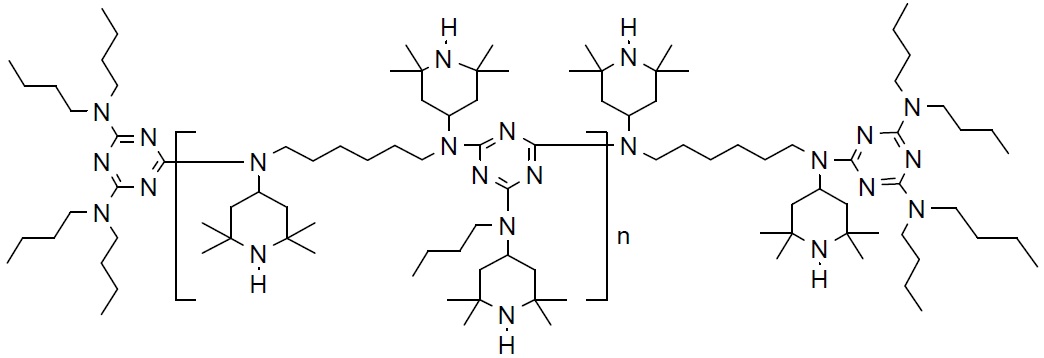 | |
| Synonyms | Light stabilizer 2020 | |
| Applications and properties | Tiangang® HS-200 (Light Stabilizer 2020) is a high-end polymeric HALS and an import substitute for 2020, with good resin compatibility and good suppression of color and gas-fume discoloration. | Applications and propertiesTiangang® HS-200 (Light Stabilizer 2020) is a high-end polymeric HALS and an import substitute for 2020, with good resin compatibility and good suppression of color and gas-fume discoloration. |
Where it is used, and at what loading
Suitable for polyolefins (PP, PE), polyurethane, polyamide, polyacetal and polyester. Thin and thick parts call for different grades: thin sections suffer from volatilisation and migration, thick sections from surface bloom.
| Film, tape, nonwoven | 0.1 – 0.5% |
|---|---|
| Injection moulded and thick-wall parts | 0.3 – 1.0% |
| Fibre and monofilament | 0.3 – 0.8% |
Figures above are typical industry ranges, not guaranteed values. The actual loading depends on wall thickness, design life and the other additives in the system, and should be established by a loading ladder on the real formulation.
Choosing between similar grades
Three things decide the choice for HS-200: molecular weight and volatility, basicity, and compatibility with the other components in the system. A polymeric HALS of the 2020 class: broad resin compatibility and low gas-fade discolouration, suited to light colours and low-odour parts.
Frequently asked questions
Is this grade meant for thin or thick parts?
It depends on molecular weight and migration tendency. Low-MW grades diffuse quickly and act early but volatilise and migrate over time; high-MW grades (HS-950, HS-362, BW-10LD) suit long-service outdoor parts. Tiangang offers both, so the choice follows wall thickness and design life.
Is it worth combining with a UV absorber?
Yes, they cover different stages. The UV absorber shields incoming UV energy; the HALS scavenges radicals that have already formed. Agricultural film, automotive exterior and PV backsheet usually need both to reach their design life.
What happens if the loading is too high?
Beyond the compatibility limit the additive blooms to the surface, which wastes material and harms appearance and print adhesion. Protection also stops scaling linearly. Our practice is a loading ladder on the actual system, then fix the cost-performance knee.
The figures and guidance above follow Tiangang's published technical material and common industry practice. For a specific formulation, refer to the batch COA and the technical agreement between the parties.
Certifications
- National High-Tech Enterprise
- Vice Chairman Unit, China Plastics Processing Industry Association (CPPIA)
- Vice Chairman Unit, Agricultural Plastics Branch, China Agricultural Plastics Application Technology Society
- Member, Ageing Methods Subcommittee, National Technical Committee on Plastics (SAC/TC15/CS5)
- Member, Society of the Plastics Industry (SPI), USA
Recommended Products
Products
UV Absorbers
400-094-4362
- Tiangang elected Executive Deputy Director Unit of CPPIA Agricultural Film Committee
- Tiangang wins Leading Award at Beijing TV Innovation Institute finals
- Tiangang concludes CHINAPLAS 2023 on a high note
- First industry-academia-research base in Weishanzhuang Town lands at Tiangang
- Tiangang-Tinaco BUCT scholarship award ceremony 2021-2022
Share the substrate, processing conditions and target service life to save a round of back-and-forth.
Start an inquiry 400-094-4362