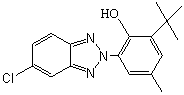
Tiangang® UV-326
Uv absorber (uva) · UV-326
UV absorber suitable for a variety of plastics and other organic substrates, especially polyolefins, and cold cured polyesters. It has a wide range of indirect food approvals in polyolefins. It features strong UV absorption, and low volatility
In one sentence: A benzotriazole UV absorber with molecular weight 315.8 and a 138 – 141 °C melting point, for polyolefins and low-temperature-cured polyester resins.
- Molecular weight: 315.8 g/mol (source: spec table on this page)
- Melting point: 138-141 °C (source: spec table on this page)
- Specific gravity (20 °C): 1.32 g/cm³ (source: spec table on this page)
- Temperature at 2% weight loss: 215 °C (source: spec table on this page)
- Flash point: 238 °C (source: spec table on this page)
What it is
Tiangang® UV-326 is a UV absorber (UVA). A UV absorber takes in 280–400 nm radiation and dissipates it as heat, acting as a filter layer at the surface. It does not scavenge radicals itself. Product identifiers: chemical name Phenol, 2-(5-chloro-2H-benzotriazole-2-yl)-6-(1,1-dimethylet; CAS 3896-11-5; molecular weight 315.8 g/mol;
Technical data
Chemical name | Phenol, 2-(5-chloro-2H-benzotriazole-2-yl)-6-(1,1-dimethylethyl)-4-methyl- | |||||||||||||||||||||||||||||||||
CASnumber | 3896-11-5 | |||||||||||||||||||||||||||||||||
Structure
|
| |||||||||||||||||||||||||||||||||
Molecular weight | 315.8 g/mol | |||||||||||||||||||||||||||||||||
Applications and properties
|
Tiangang® UV-326Added to polymer materials it effectively extends service life under sunlight and other UV radiation. Depending on the application it is added at 0.10-1.0%Tiangang® UV-326Tiangang® series of hindered amine light stabilizers (HALS Appearance Melting point Specific gravity, Weight-loss temperature 2%,°C Flash point Tiangang® UV-326 Slightly yellow powder 138-141 1.32 215 238 AS® D-93 Tiangang® UV-326 Acetone Chloroform Hexane Methanol Water 1 11 1 0.1 < 0.01 Tiangang® UV-326 The product is hygroscopic. Store sealed, dry and away from light below 50Cardboard box/2025/ Molecular weight around 315 — mid-range: a workable balance between diffusion speed and retention. The difference from HALS is where it works: a UV absorber depends on its own absorption cross-section, so it is most visible in transparent film, coatings and sheet with a long optical path. In carbon-black or opaque systems its contribution is limited. Figures above are typical industry ranges, not guaranteed values. The actual loading depends on wall thickness, design life and the other additives in the system, and should be established by a loading ladder on the real formulation. Three things decide the choice for UV-326: molecular weight and volatility, basicity, and compatibility with the other components in the system. General-purpose benzotriazole with strong absorption and good migration resistance for polyolefins and engineering plastics; for very high processing temperatures look at 234 or 360. Benzophenones such as UV-531 are cost-effective and compatible but absorb at shorter wavelengths and migrate over time. Benzotriazoles (UV-326, 327, 328) absorb more strongly and resist migration, which is why engineering plastics mostly use them. Triazines (UV-570, UV-630) give the highest heat and weathering resistance for high-temperature processing and demanding outdoor parts. Engineering plastics are processed at 250–300 °C. A standard UV absorber volatilises or decomposes in that window, losing active content and contaminating the tool. High-temperature grades have a higher decomposition temperature and survive the process. Acid-base interaction. Some UV absorbers and highly basic HALS interfere with each other in the same system and lose synergy. Our T-series packs are formulated with both sides of that balance in mind. The figures and guidance above follow Tiangang's published technical material and common industry practice. For a specific formulation, refer to the batch COA and the technical agreement between the parties. |