
Technical Challenges and Solutions
Technical Challenges and Solutions
This page does not cover industry principles, only problems. Each difficulty sets out three things clearly: what the failure mechanism is, how Tiangang solves it, and how it is verified.
The value of the additive industry lies not in "recommending products" but in solving one concrete failure problem. This page is therefore organized by problem rather than by product. If you are running into any of the phenomena below, the answer you need may be here.

Failure diagnosis matters more than formulation recommendation - confirm the failure mode first, then discuss solutions
0. Tiangang's first move: diagnose firstDiagnosis First
Molecular weight first: HS-362 and HS-625 are polymeric grades that resist extraction.
The problems customers describe are usually symptoms: "it turned white", "it went brittle", "it yellowed", "it fails to meet spec". But behind the same symptom there can be completely different chemical causes, and the corresponding solutions are entirely different.Recommending products before the cause is understood is the most common waste in the additive industry. So the first step of Tiangang's technical service is always diagnosis.
| Phenomenon described by the customer | Possible causes (to be ruled out one by one) | Tiangang's diagnostic means |
|---|---|---|
| Surface blooming, haze, chalking | 1. insufficient compatibility between additive and resin; 2. uneven dispersion; 3. migration and blooming | microscopy of bloom morphology; FTIR confirmation of bloom composition; comparison of samples from different dispersion processes |
| Yellowing, browning | 1. photooxidation generating quinone chromophores; 2. acidic by-products from flame retardants catalyzing degradation; 3. acidic substances released by the resin itself, such as acetic acid from EVA | colorimeter measurement of the ΔYI distribution; FTIR tracking of carbonyl changes; XPS surface analysis; control-group elimination |
| Chalking, gloss loss, embrittlement | 1. conventional photooxidation chain degradation; 2. loss of light protection after flame retardants consume HALS; 3. insufficient antioxidant phase | xenon-arc accelerated aging with tensile retention tracking; flame-retardant / non-flame-retardant same-formulation comparison |
| Rapid tensile loss, life falling short of spec | 1. extraction causing additive loss; 2. molecular weight already reduced (recycled material); 3. gel defects | additive residue analysis after media immersion; GPC measurement of molecular weight distribution; comparison against the virgin material baseline |
| Color drift and surface chalking on flame-retardant parts | flame retardants produce acid that protonates HALS (the industry's biggest difficulty) | pH measurement; accelerated aging comparison of flame retardant and HALS mixed separately |
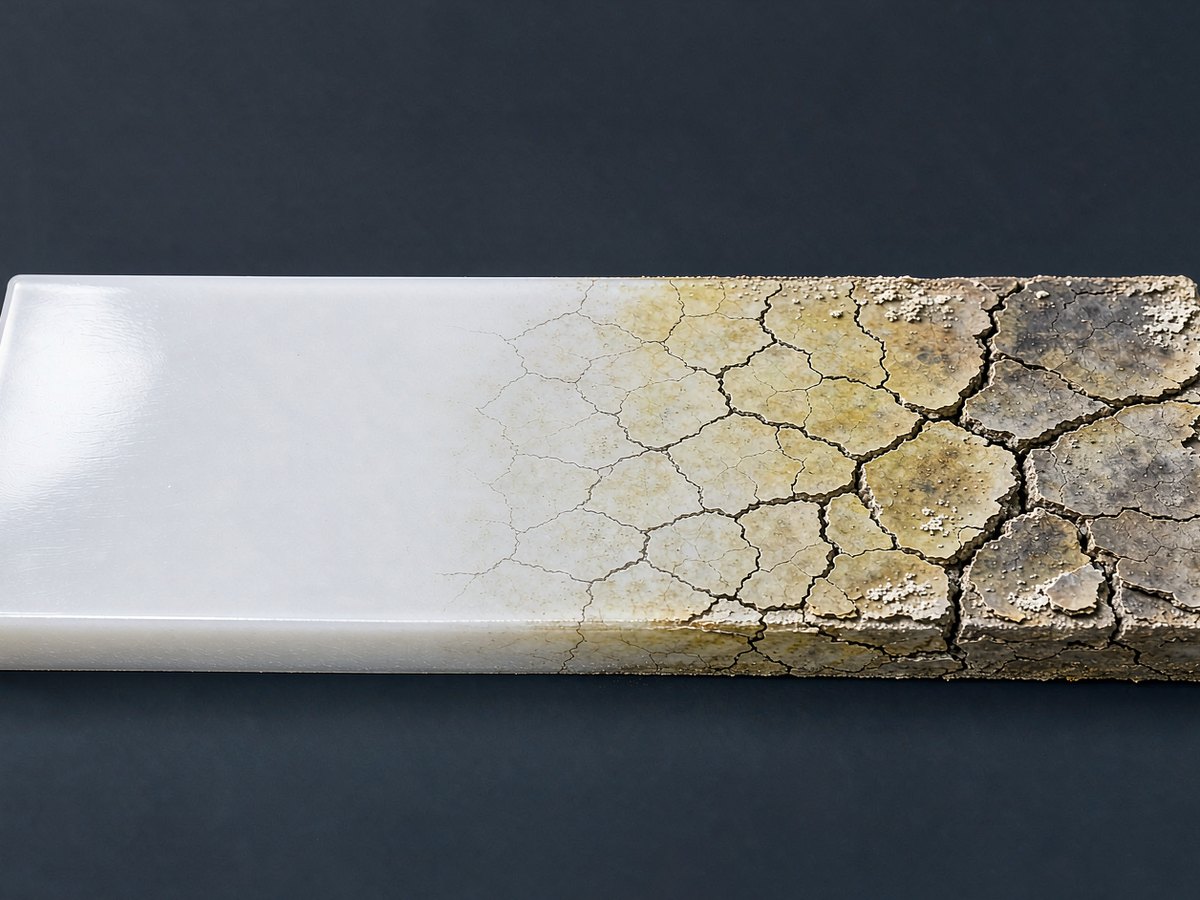
Surface cracking, chalking, discoloration - when the additive system is consumed by internal friction, appearance and mechanical performance fail together
Three levers do the work.and HS-962 is the polymeric composite, together with the low-basicity HS-330 for acid-filler systems. Dispersion second: most bloom is not over-dosing but under-mixing, so MB0607-1/-2, TGUVFQ2001PE, MB6250PP20 and MB6251PP20 deliver the additive pre-dispersed. Sequence third: patent CN113388193A specifies a low-basicity HALS of 2,000-4,000 weight-average molecular weight, which is what XT-8 and the liquid HS-112 provide, and patent CN114276616A (NEV battery components) shows that hindered benzoates suppress the acid effect of halogen-free flame retardants, which is where AO-427 is used to improve dispersion of the retardant itself.
1. The chemical opposition of flame retardancy and weathering: Tiangang's direct answerFlame Retardancy vs. Weathering
The three-in-one flame retardant reduces acid production at the source + XT-8.
Failure mechanism
HALS captures free radicals through the lone pair of electrons on nitrogen atoms to complete the light-stabilization cycle, which requires the nitrogen to remain basic; flame retardants (brominated, phosphorus-based, APP intumescent systems) release acidic products such as HBr and phosphoric acid under heat or light, protonating the nitrogen, and light-stabilization capability fails immediately. This is not a contradiction that formulation technique can circumvent - the two functions are in direct chemical opposition. Tiangang lists this as the first item on the tackling list, because it is the question customers ask most often, and the hardest to answer.
| System | Accelerated aging performance |
|---|---|
| PP with brominated flame retardant (with or without 0.5 wt% HALS) | approximately 400 hours, surface cracking appears |
| PP with APP intumescent flame retardant + HALS | stable up to approximately 1,800 hours |
| PP without flame retardant + HALS (control) | approximately 2,500 hours |
| flame-retardant + NOR-type stabilizer | approximately 4,000 hours (ASTM G26 spray) |
| flame-retardant + conventional HALS | approximately 800 hours, then fails |
Tiangang's three solution paths
Because it is a chemical opposition, no universal solution exists. Tiangang's product line happens to cover three viable paths - which one to use depends on the customer's flame-retardant system type and cost constraints.
| Path | Approach | Corresponding Tiangang product |
|---|---|---|
| 1. Reduce the acidity of the flame retardant itself | Keep the flame-retardant system from emitting acidic by-products in the first place, eliminating consumption at the source. The industry already has patent routes that adjust the flame-retardant system pH to 6.5-7 through a weak-base buffer system | FR-810A — NOP™ patent, flame retardancy + light stabilization + thermal stabilization in one product |
| 2. Switch to low-basicity / NOR-type light stabilizers | Reduce the basicity of nitrogen so it is less easily protonated in acidic environments. Domestic patent CN113388193A explicitly requires a low-basicity hindered amine with a weight-average molecular weight of 2,000-4,000 | XT-8 — an original CAS structure high molecular weight NOR; HS-112 — a low molecular weight liquid NOR |
| 3. Block with an intermediate layer | Add hindered benzoate buffers, or microencapsulate / silane-coat the flame retardant. Domestic patent CN114276616A (target application: new energy vehicle battery surrounding components) points out that hindered benzoates can effectively suppress the influence of acidic components of halogen-free flame retardants on hindered amines | hindered benzoate types + AO-427 — improves dispersion and the dispersion state of the flame retardant |
Tiangang's reminder: addition sequence matters more than dosage
An easily overlooked process variable: during high-shear extrusion the flame retardant may decompose slightly, releasing acidic by-products. Conventional COA only controls purity, melt-phase acid value drift is a hidden variable beyond the COA, and it keeps consuming HALS until the part turns white.
Tiangang's recommended addition sequence is: add the acid absorbent first (hydrotalcite, epoxy-functional polymer) → then the flame retardant, ensuring dispersion → the light stabilizer last, while monitoring the melt temperature ceiling. The order of these three steps is itself part of Tiangang's technical service - with the same additive, a wrong order gives a completely different result.
the NOR type improves acid resistance, and with hindered benzoate buffering a complete closed loop is formed. Suitable for outdoor energy storage enclosures, battery pack surrounding components, cable sheathing and other "flame retardancy + outdoor weathering" dual-constraint conditions.
2. Blooming in thin films: enough, but it cannot get out - Tiangang qualifies first, then selectsBlooming in Thin Films
Agricultural film, PV backsheet and stretch film keep getting thinner, while there is no room for the additive loading to fall proportionally. Too little loading and weathering fails to meet spec; above the compatibility threshold and blooming appears. Under the thinning trend this window is often only a few tenths of a percent wide.
Tiangang's three solutions
| Solution | What Tiangang does specifically | Corresponding product |
|---|---|---|
| Raise molecular weight | Reduce migration tendency at the root | HS-362, a high molecular weight polymeric type; HS-625, polymeric and extraction-resistant (provincial/ministerial science and technology progress award); HS-962, a polymeric high molecular weight system |
| Masterbatch to improve dispersion | the common trigger for blooming is not "too much added" but "not added evenly" - local high-concentration zones break through the compatibility threshold | MB0607-1/-2, TGUVFQ2001PE, MB6250PP20 / MB6251PP20 |
| Processing aid pairing | Improve processing flow and dispersion uniformity, reducing the probability of local high-concentration zones | AO-427 |
3. Sulfur and chlorine resistance: Tiangang uses low-basicity NOR to withstand the direct opponent of light stabilizationSulfur & Chlorine Resistance
Tiangang's XT-8 has turned this into a quantifiable indicator.
Sulfonylurea fungicides inside greenhouses, sodium hypochlorite bleach used in artificial turf maintenance, and chlorine-containing substances in some industrial atmospheres - they all neutralize basic HALS. This is not a question of "improving weathering", but of the direct opponent of the light-stabilization principle.
Leading international manufacturers have already listed "protection under high-concentration sulfur and chlorine exposure" as a standalone product selling point, which shows this is a real customer pain point rather than a marketing concept.
| Tiangang product | Sulfur resistance | Chlorine resistance | Note |
|---|---|---|---|
| XT-8 | 3,000–7,000 ppm | ≤ 850 ppm | N-alkoxy structure reduces basicity, delaying protonation |
| Hindered benzoate types | synergistic | synergistic | Low tinting strength, good chemical stability, acid and alkali resistant - suitable for halogen-containing flame-retardant or peroxide polyolefin systems |
| T-68 / T-66 / T-69 | already formulated in | already formulated in | Agricultural film and turf compound package - Tiangang has solidified the buffer components into the specification |
4. Extraction and long-term contact: Tiangang's only answer is polymeric productsExtraction & Long-term Contact
In liquid cooling pipes, and in pipes and seals in long-term contact with chemical media, low molecular weight additives are gradually extracted by the medium. Initial performance is normal, and after long-term use it fails suddenly - a typical "cliff-edge" curve.
Tiangang's solution has no second path: polymeric high molecular weight additives - they are inherently non-volatile and extraction-resistant. For long-term contact scenarios such as data center liquid cooling pipes, this is the only effective technical route, with no shortcut.
Designed for extraction resistance in polymers; winner of a provincial/ministerial science and technology progress award. "Extraction resistance" is a quantifiable, testable performance, and a performance indicator recognized by a third-party award is more convincing than any adjective.
5. Recycled material: Tiangang redesigns the stabilization system rather than copying the virgin formulationRecycled Materials
The EU PPWR ((EU) 2025/40) has mandated minimum recycled content of 30% for single-use beverage bottles and 35% for other plastic packaging by 2030, rising to 65% respectively by 2040. This is a certain incremental market for the additive industry - but Tiangang believes formulation capability is the real threshold, so it has made this a routine work item for the application technical team.
Why Tiangang does not advocate copying the virgin formulation
- molecular weight has already dropped - recycling puts the material through 2-3 high thermal histories (shear degradation); the molecular chains themselves are already shorter and the antioxidant reserve is reduced.
- acidic oxide residues - acidic products generated during thermal history keep consuming HALS.
- impurity and pigment residues - cross-contamination brings uncertain catalytic degradation pathways.
- odor problems - degradation products bring odor, a particular sensitivity for automotive and food-contact applications.
Tiangang's approach: redesign in five steps
| Step | What Tiangang does specifically |
|---|---|
| 1. Measure the baseline first | Measure the molecular weight distribution, GPC curve, initial color and odor of the recycled material, and compare against the virgin material to establish how large the "deficit" is |
| 2. Re-formulate the antioxidant phase | Recycled material needs a higher level of antioxidant protection than virgin material, and must cover a wider molecular weight distribution |
| 3. Select the right light stabilizer | For acid residue, choose the right basicity / low-basicity balance; favor high molecular weight grades (XT-8 / HS-362) to reduce extraction and migration |
| 4. Add via masterbatch | Recycled material has many impurities and is hard to disperse - masterbatching is almost essential |
| 5. Accelerated validation | run a same-condition comparison against the customer's virgin formulation, tracking ΔE and mechanical retention |
6. Outdoor energy storage enclosures: Tiangang folds four difficulties into one solutionOutdoor Energy Storage Enclosures
This is a scenario that stacks all the difficulties together, and it deserves its own section, because in the laboratory it requires four technologies to hold at the same time.
| Constraint | Requirement | Conflict point | Tiangang's response |
|---|---|---|---|
| Flame retardancy | UL94 V-0 | flame retardant produces acid that consumes HALS | FR-810A (reduces acid production at the source) |
| Outdoor | 25 years | long-term UV aging | XT-8 (low-basicity NOR) |
| Temperature | -40°C ~ +85°C, long-term cycling | thermal-oxidative degradation + thermal shock | HS-962 (high-temperature processing stability) + antioxidant phase |
| High humidity | high-humidity environment, long-term | accelerated hydrolysis and ion migration | high molecular weight grades reduce migration |
| Resin | PC / PC-ABS / flame-retardant PP etc. | stabilization needs differ greatly between resins | design separately by resin and run same-condition comparisons |
The result of four stacked constraints is: a single-additive solution almost certainly fails. It has to be a combined solution of "flame-retardant system + light-stabilization system + antioxidant system + process control". Domestic patents already explicitly point the target application of halogen-free flame-retardant PP at "new energy vehicle battery surrounding components", showing this demand is an industry consensus.Tiangang's FR-810A + XT-8 combination is a productized packaging of this consensus - folding four difficulties into one grade selection.
7. Summary of Tiangang's diagnostic processHow Tiangang Handles Your Case
- Diagnosis - first reproduce the customer's failure mode with aging tests, to establish whether it is photooxidation, thermal-oxidative degradation, flame-retardant acid production, extraction migration, or impurity acid residues.
- Grade selection - across four dimensions of UV absorber, hindered amine light stabilizer, antioxidant and flame retardant, choose grades that are compatible with the resin and do not react with other components of the system.
- Compatibility - determine the addition ratios and sequence of the four additive classes.
- Validation - xenon-arc, QUV and thermal-oxidative aging in parallel, with performance tracking of mechanical, optical and color properties.
- Tracking - long-term data return from outdoor exposure bases, correcting the formulation model.
These five steps cycle continuously, and constitute the actual working method of Tiangang's technical service. What the customer truly buys is not an additive, but a formulation capability that can be verified, traced and continuously corrected.
Have a specific problem to solve?
Tell Tiangang's technical team the phenomenon you are facing, your resin and service conditions; we will run a failure diagnosis first, then judge whether it falls within the solvable range. The diagnosis itself is usually more valuable than customers expect.
Contact a technical representativeCertifications
- National High-Tech Enterprise
- Vice Chairman Unit, China Plastics Processing Industry Association (CPPIA)
- Vice Chairman Unit, Agricultural Plastics Branch, China Agricultural Plastics Application Technology Society
- Member, Ageing Methods Subcommittee, National Technical Committee on Plastics (SAC/TC15/CS5)
- Member, Society of the Plastics Industry (SPI), USA
Recommended Products
Products
UV Absorbers
400-094-4362
- Tiangang elected Executive Deputy Director Unit of CPPIA Agricultural Film Committee
- Tiangang wins Leading Award at Beijing TV Innovation Institute finals
- Tiangang concludes CHINAPLAS 2023 on a high note
- First industry-academia-research base in Weishanzhuang Town lands at Tiangang
- Tiangang-Tinaco BUCT scholarship award ceremony 2021-2022
Share the substrate, processing conditions and target service life to save a round of back-and-forth.
Start an inquiry 400-094-4362