
Material Stability for Automotive Interiors and Cabins
Interior parts are technically harder than exterior parts. The reason is direct: exteriors only need to hold their appearance where it is "visible", while interiors must pass weather resistance, low VOC, low odor, low fogging and flame retardancy - five tests at once, and between these indicators there is a real mutual constraint - for example, some low-molecular-weight additives that enhance weather resistance also increase fogging and odor contributions.
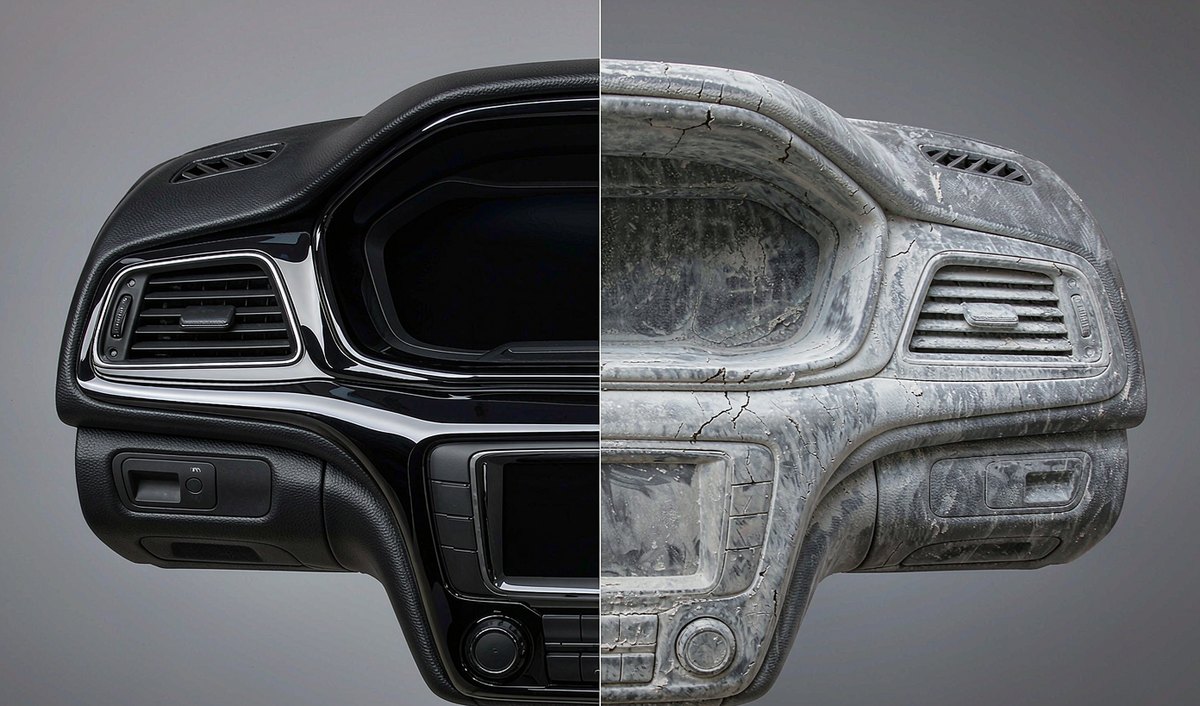
1. The core contradiction of interiors
Interiors are gated by VOC of 50 μg/g or less under VDA 278 and odour of grade 3.0 or less under VDA 270.
| Indicator | Standard and typical limits | Source and meaning |
|---|---|---|
| VOC | VDA 278: VOC ≤50 μg/g (FOG ≤0.5 mg) GB/T 27630-2011: 8 limit values | Thermal desorption GC/MS. VOCs accumulate in the cabin, directly affecting air-quality assessment |
| Odor | VDA 270: ≤grade 3.0 (F3: 80°C × 2 h) GMW 3205 / PV 3900 / TSM 0505G | Olfactory sensory assessment. VW, GM and Toyota all require ≤grade 3.0 |
| Fogging | DIN 75201-B / ISO 6452: ≤2 mg (some ≤1.0 mg) | Condensate deposits on the windshield - a driving-safety issue |
| Burning | GB 8410-2006: horizontal burning ≤100 mm/min FMVSS 302:≤102 mm/min | Mandatory. Chinese passenger-car interiors have been under mandatory 3C testing since 2003 |
| Weather resistance | SAE J2412 (interior xenon-arc) VW PV 1303 (420 nm + Soda filter) | Interiors receive UV filtered by the windshield and sunroof, black-panel temperature about 89°C, no water spray |
2. Tiangang's approach
2.1 Prefer polymeric high-molecular-weight grades to cut migration and fogging contributions
HS-944,HS-950,HS-622) have high molecular weight.
This is the single most important principle for interior parts.Low-molecular-weight HALS (e.g. the UV-770 family, molecular weight about 481) migrate fast and work early, but release amine compounds under sustained high temperature, contributing to fogging and odor; polymeric HALS (e.g.resist extraction and are low in volatility, making them the safer choice against limits such as VDA 278 / DIN 75201.
It should be noted that polymeric products act slightly slower and are weaker in early weather resistance, so in practice the common approach is "a polymeric base + a very small amount of low-molecular-weight surface touch-up" rather than either/or. On loadings, interior parts are typically held at HALS 0.2-0.5% and UVA 0.1-0.3%.
2.2 PVC systems: pay special attention to alkaline-HALS compatibility
Dashboard skins and seat upholstery use large amounts of flexible PVC. During processing and service, PVC continuously releases HCl, while conventional HALS is alkaline - when the two coexist, the HALS is neutralized and consumed by the HCl, and the PVC side also risks bloom or frost from the neutralization products.
Tiangang's approach: in PVC-related systems, give priority to low-alkalinity NOR products that do not react with acidic substances——XT-8 (high-molecular-weight N-OR, resistant to sulfur at 3000-7000 ppm and chlorine at ≤850 ppm) and HS-112 (low-molecular-weight liquid N-OR, whose low alkalinity avoids reaction with acidic components). Compared with conventional alkaline HALS, the N-OR structure stays active in acidic environments.
2.3 Interior-part flame retardancy: GB 8410 is a hard threshold
GB 8410-2006 requires a horizontal burning rate ≤100 mm/min, a mandatory test item; the US market counterpart is FMVSS 302 (≤102 mm/min). For polymers, the usual route is to introduce flame retardants or flame-retardant copolymers, and on parts requiring both flame retardancy and weather resistance (e.g. airbag covers, some interior frames), FR-810A the "flame retardancy + light stabilization + long-term thermal stability" three-effects-in-one is the more convenient solution.
3. Quick reference by part
| Part | Common materials | Focus | Recommended direction |
|---|---|---|---|
| Dashboard substrate | PP, EPP, TPU skin | High temperature + fogging + shade difference | Polymeric HALS + AO-1010/168; use low-molecular-weight HALS cautiously on the skin |
| Dashboard skin | Flexible PVC + PU coating | Plasticizer migration, discoloration from HCl release | Ca-Zn stabilizer system; avoid alkaline HALS, or switch to the NOR type |
| Steering-wheel surface | PU, TPU | Hand sweat + UV + abrasion | AO-1010/1076 + AO-168 + UV-327 |
| Door panels / side trim | PP, ABS, TPO | Low VOC + UVA | Low-migration polymeric HALS + UV-326/327 |
| Headliner / interior trim | PP felt, PU foam, PET nonwoven | Fogging + yellowing | Low-fogging HALS; antioxidants against yellowing |
| Seat upholstery | PVC leather / PU leather / TPU | Perspiration + sunroof light transmission | NOR type or low-alkalinity system; hydrolysis-resistant additives |
| Center console / cup-holder mat | SEBS, TPE | Oil exudate and migration, fogging | Polymeric HALS + high-molecular-weight hindered phenol; avoid excess low-molecular-weight oils |
| Airbag cover | TPO / PP / PC-ABS | Long-term thermal stability + tear aging | AO-1010 + AO-168 + low-volatility HALS |
For more parts and recommended loadings, see ⑤ Selection Guide & Product Matrix. To discuss a formulation for a specific interior part, feel free to contact us.
Certifications
- National High-Tech Enterprise
- Vice Chairman Unit, China Plastics Processing Industry Association (CPPIA)
- Vice Chairman Unit, Agricultural Plastics Branch, China Agricultural Plastics Application Technology Society
- Member, Ageing Methods Subcommittee, National Technical Committee on Plastics (SAC/TC15/CS5)
- Member, Society of the Plastics Industry (SPI), USA
Recommended Products
Products
UV Absorbers
400-094-4362
- Tiangang elected Executive Deputy Director Unit of CPPIA Agricultural Film Committee
- Tiangang wins Leading Award at Beijing TV Innovation Institute finals
- Tiangang concludes CHINAPLAS 2023 on a high note
- First industry-academia-research base in Weishanzhuang Town lands at Tiangang
- Tiangang-Tinaco BUCT scholarship award ceremony 2021-2022
Share the substrate, processing conditions and target service life to save a round of back-and-forth.
Start an inquiry 400-094-4362