Light-Stabilizer Solutions for Automotive Exterior Parts
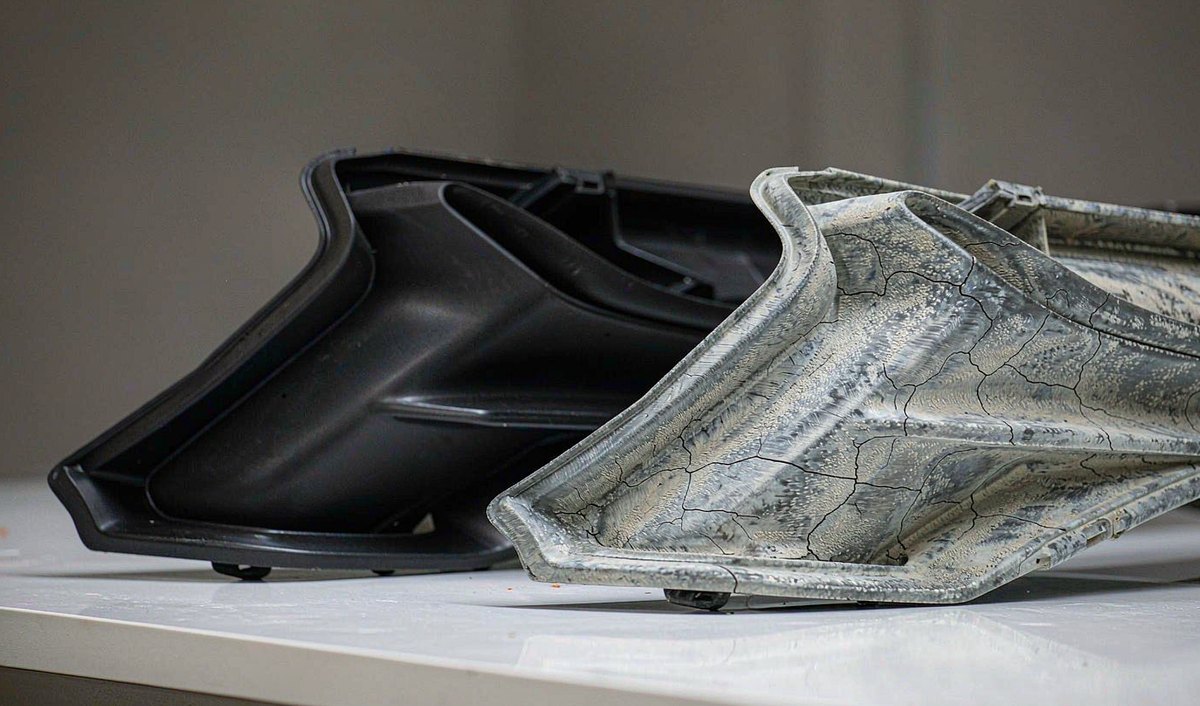
Automotive exterior parts are where aging is most visible and appearance demands are highest of components. They carry none of the interior's VOC and fogging pressure, yet must face year-round unobstructed UV radiation, midday heat, gravel impact and rain, snow and salt spray. A grayed bumper or a brittle door-sill guard is usually judged a "quality problem" the moment the customer test-drives the car - the weather resistance of exterior parts is, in essence, brand image.
1. Exterior-part materials and failure modes
| Part | Common materials | Main aging issues |
|---|---|---|
| Front/rear bumpers, lower sill protectors | PP, PP+EPDM (TPO) | UV causes powdering, gloss loss, color fade; brittle at low-temperature impact; gravel damage |
| Front grille, air intake | PP, ABS, PC/ABS | the above plus salt spray, asphalt and exhaust pollution; often paint-free black parts |
| Exterior mirror housings, wheel arches | PP, TPO | UV powdering; often black or paint-free parts |
| Roof racks, spoilers | PC/ABS, PPA, PPS | High roof-surface temperatures in summer, UV + high temperature + vibrationcompound |
| Spare-tire cover | PP, EPDM | UV + ozone (EPDM systems additionally need an antiozonant) |
| Body weatherstrips | EPDM, TPV, SEBS | Ozone + UV + thermal cycling, leading to cracking and compression set |
2. Tiangang's recommended solutions
2.1 Staged interception: polymeric base, low-molecular-weight surface touch-up
The proven approach for exterior parts is a four-layer combination of "polymeric HALS + low-molecular-weight HALS + UV absorber + antioxidant":HS-944 / HS-950 Polymeric products of this type have high molecular weight, resist extraction and resist blooming, providing the base weather resistance over long cycles; HS-770 and other low-molecular-weight products migrate faster, building effective concentration at the part surface - particularly suited to thin-wall parts, fibers and tapes; the two combined are what the industry calls "staged protection".
| Protection layer | Recommended product | Function | Typical loading |
|---|---|---|---|
| Polymeric base | HS-944 / HS-950 | Long-cycle base weather resistance, low volatility and migration | 0.2–0.5% |
| Low-molecular-weight surface protection | HS-770 / HS-622 | Surface-migration protection, marked effect on thin-wall parts | 0.1–0.3% |
| UV front-end interception | UV-326 / UV-328 / UV-360 | Preferentially absorbs 290-400 nm UV | 0.2–0.4% |
| Thermo-oxidative protection | AO-1010 + AO-168 or AO-B215 | Protects the process and long-term thermal stability | 0.1–0.3% |
| Paint-free black parts | Carbon black / carbon-black masterbatch (used with the above system) | The dark part itself resists UV; HALS suppresses carbon-black bloom | Carbon black about 2% |
2.3 A few exterior parts also have flame-retardancy requirements
Conventional exterior parts are not required to be flame retardant, but the following scenarios may be involved: Roof-load-bearing parts such as roof racks and spoilers (some OEMs manage these to interior standards), Spare-tire covers and battery-pack outer guards (underbody guards on NEV models often must meet a flame-retardancy rating), and Commercial and special-duty vehiclesdecorative parts.
Where both weather resistance and flame retardancy are needed here, the FR-810A polymeric halogen-free flame retardant combines flame retardancy, light stabilization and long-term thermal stability in one product, reaching flame-retardancy ratings at low loadings (0.2-1.2%) and avoiding the dilemma of "acidic flame-retardant by-products neutralizing conventional HALS and causing premature weather-resistance failure". More on flame retardancy: ③ Wiring, Electrical & Flame Retardancy.
2.2 Ready to use out of the bag: the T-78 automotive-modified dedicated light-stabilizer package
If a customer prefers not to compound the four additives themselves, Tiangang offers the T-78 automotive-modified dedicated light-stabilizer package. Its design logic: light stabilization and antioxidation in synergy, staged interception of aging, dual protection in processing and use, all pre-blended. Compared with customers compounding in-house, the package approach reduces batch deviation in compounding ratios, reduces incoming-inspection items and lowers compounding dust - of practical significance in an automotive supply chain that demands batch consistency and 4M change management.
3. Validation recommendations
For aging validation of exterior parts, the industry commonly uses the following combination (specifics per the OEM's corporate standard):
| Validation item | Standard | Metrics of interest |
|---|---|---|
| Exterior xenon-arc aging | SAE J2527 (formerly SAE J1960) | Includes front/back spray, black-panel temperature about 70°C; focus on shade difference ΔE and impact-strength retention |
| General xenon-arc | ISO 4892-2 / GB/T 16422.2 | Method A outdoor conditions; for cross-material comparison screening |
| Natural-exposure control | ISO 877 / Florida outdoor exposure | Serves as the baseline reference for accelerated tests |
| Post-aging assessment | OEM corporate standard | Shade difference ΔE ≤2 (some ≤3); 50% elongation-at-break retention ≥50%; impact-strength retention ≥70%; gloss retention ≥80% |
Tiangang can assist with formulation screening and aging testing - please contact our technical team. To look up formulations quickly by part, see ⑤ Selection Guide & Product Matrix.
Certifications
- National High-Tech Enterprise
- Vice Chairman Unit, China Plastics Processing Industry Association (CPPIA)
- Vice Chairman Unit, Agricultural Plastics Branch, China Agricultural Plastics Application Technology Society
- Member, Ageing Methods Subcommittee, National Technical Committee on Plastics (SAC/TC15/CS5)
- Member, Society of the Plastics Industry (SPI), USA
Recommended Products
Products
UV Absorbers

- Tiangang elected Executive Deputy Director Unit of CPPIA Agricultural Film Committee
- Tiangang wins Leading Award at Beijing TV Innovation Institute finals
- Tiangang concludes CHINAPLAS 2023 on a high note
- First industry-academia-research base in Weishanzhuang Town lands at Tiangang
- Tiangang-Tinaco BUCT scholarship award ceremony 2021-2022