
Topic 03: Additive Solutions for Small Appliances and Kitchen Appliances
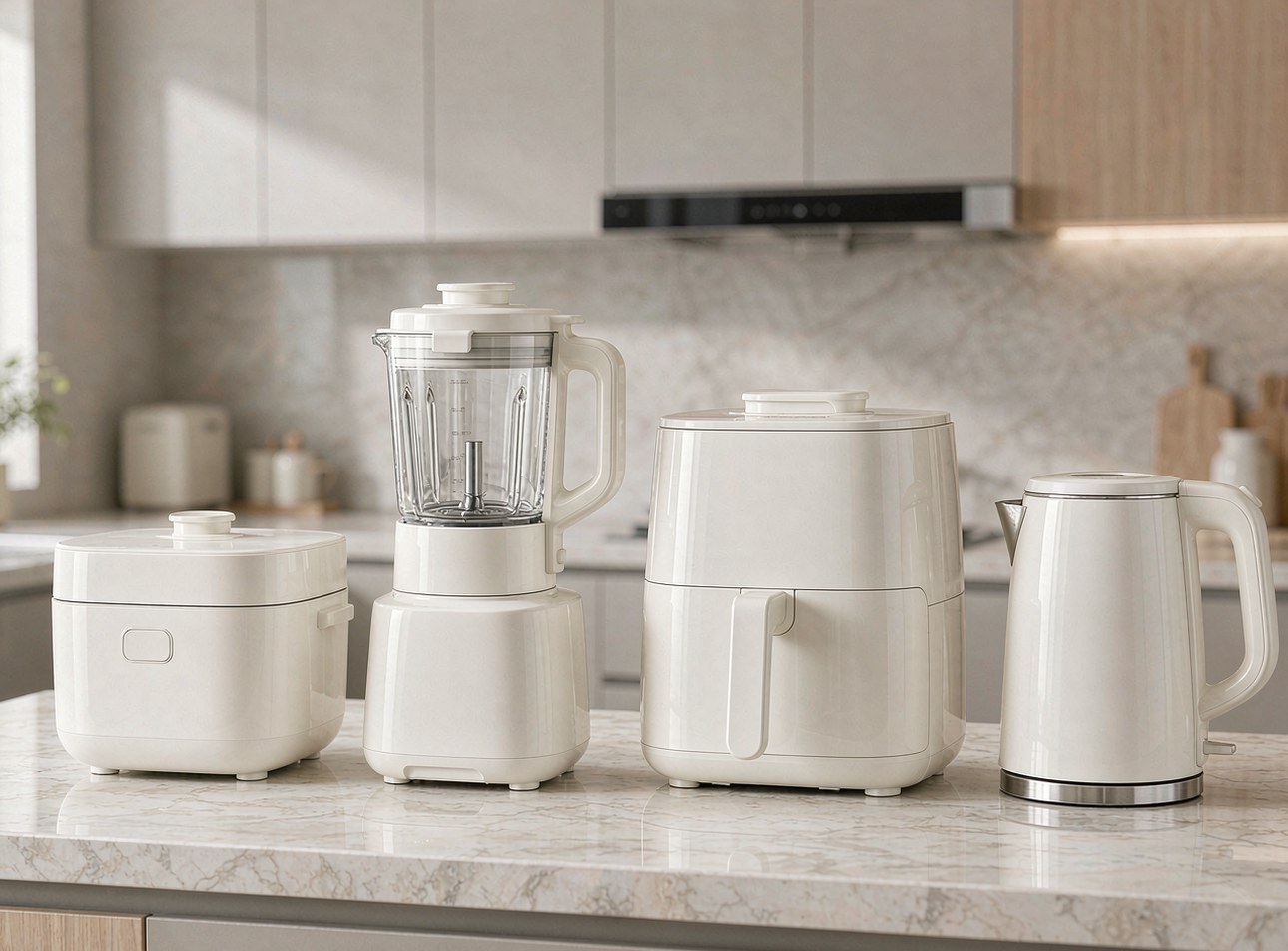
Topic 03 · Small Appliances and Kitchen Appliances
1. Additive demand characteristics of small appliances
Unmodified ABS generally reaches only HB or V-2, dripping during combustion and possibly igniting the degreased cotton below.
1.1 More extreme high-temperature conditions
Small appliances often run hotter than large appliances. Air-fryer baskets, microwave cavities and the area around dishwasher heating elements can reach 80-120°C.This puts "long-term thermo-oxidative stability" ahead of "UV resistance" in priority - many small appliances are not directly exposed to sunlight, but sustained oxidation at high temperature likewise leads to strength loss and appearance degradation.
1.2 Round-the-clock contact with grease and detergents
Kitchen appliances are in long-term contact with grease, detergents, food residues and acidic substances. Grease accelerates surface migration and extraction of additives; acidic substances neutralize the basicity of HALS.This is the special challenge that sets small appliances apart from other appliance categories.
1.3 More widespread flame-retardancy requirements
GB 4706.1 (equivalent to IEC 60335-1) evaluates the flame retardancy of non-metallic housings mainly through glow-wire and needle-flame tests; UL 94 horizontal/vertical burning is the most commonly cited yardstick for plastics flame retardancy. Small-appliance housings, handles and power boxes are usually required to reach V-0.
1.4 Paint-free and appearance upgrades
Small-appliance appearance parts widely use paint-free PC/ABS alloys - robot vacuum housings, water purifier panels and oven housings are all large-scale application scenarios. Paint-free systems require additives to be free of blooming, free of frost, and light in initial color.
2. Typical categories and service conditions
Air fryers and ovens take PP or PC-ABS at 100 °C and above, and must reach V-0 in basket, housing and handle.
| Category | Common substrate | Key components | Condition highlights | Flame-retardancy requirement |
|---|---|---|---|---|
| Air fryer / oven | PP / PC-ABS / non-stick coating | Basket, housing, handle | High temperature 100°C+ / grease / repeated cleaning | V-0 (housing) |
| Dishwasher | PP / ABS / 304 composite | Tub, spray arm, door seal | Sustained hot water + detergent + strong spray | V-1~V-0 |
| Range hood | ABS / PP / PC-ABS | Deflector, panel, volute | High temperature + grease + frequent cleaning | V-1 |
| Blender / food processor | PC / POM / PA | Cup, blade base, transmission | High-speed rotation + impact load | V-0 (motor base) |
| Robot vacuum | Paint-free ABS / PC-ABS | Housing, dust bin, sensor cover | Indoor light + dust + electrostatic adsorption | V-1 |
| Portable ice maker | PP / ABS | Housing, water tank, flow guides | Outdoor + low temperature + frequent handling | V-1 |
| Water purifier / dispenser | Paint-free ABS / PC-ABS | Panel, housing, water-path parts | Long-term water contact + indoor light | V-1 |
3. Flame retardancy + weather resistance dual compliance: the role of FR-810A
Flame retardancyHalogen-freeThree effects in oneTiangang® FR-810A polymeric halogen-free flame retardant
A new polymeric NOR halogen-free flame retardant based on hindered-amine (HALS) chemistry, combining flame retardancy and light stabilization in one. This is the key to solving "flame retardancy harms weather resistance": traditional phosphate ester flame retardants are acidic and neutralize classic HALS; FR-810A, by contrast, is built on hindered-amine chemistry, does not antagonize HALS - it works in synergy instead.
- Higher temperature resistance: polymeric high-molecular-weight structure, recommended processing temperature ≤250°C
- Low volatility, low migration, low extraction: a true polymeric structure, long-lasting
- Compliance-friendly: compliant with REACH / TSCA / FDA, suitable for demanding scenarios such as food contact
- Benchmark performance: recommended loading 0.2-1.2% (benchmarked against BASF Flamestab® NOR 116 at 0.5-1.5%), lower loading
4. Tiangang's recommended formulations for small appliances
The following are starting points (by weight). Flame-retardancy ratings must be confirmed by testing for the specific grade and wall thickness.
| Component / scenario | Tiangang recommendation | Effective loading | Why this one |
|---|---|---|---|
| Air-fryer basket PP, 100°C+ sustained high temperature |
AO-427 + HS-362 Processing additive + blended light-stabilizer package |
AO-427 0.3% – 0.5% HS-362 0.4% – 0.6% |
AO-427 (CAS 42774-15-2, melting point 268-275°C) provides both thermal and processing stability, and improves dyeing performance - uniform dyeing of pelletized PP baskets with small shade differences often affects yield more than 20% more weather resistance |
| Housing (flame-retardant V-0) PC-ABS |
FR-810A Polymeric halogen-free flame retardant |
0.5% – 1.0% (flame-retardancy rating to be confirmed by testing) |
Flame retardancy + light stabilization + long-term thermal stability, three effects in one, with the proprietary NOP™ international patent. With it there is no need to add HALS separately to make up weather resistance - in the traditional "flame retardant + classic HALS" scheme HALS is often neutralized by acidic by-products, a problem FR-810A structurally sidesteps |
| Dishwasher tub PP + detergent immersion |
HS-962 | 0.5% – 0.7% | Good water-extraction resistance is the core indicator for this condition; with no direct sun exposure, no additional UV-A is needed |
| Robot vacuum housing Paint-free ABS / PC-ABS |
T-81 or HS-6608 | T-81 feed 0.5% - 0.8% HS-6608 0.6% – 1.0% |
HS-6608 is designed specifically for PP, ABS and other modified materials, with a bulk density of 570-580 g/L for easy metering; the core demands of paint-free appearance parts are low blooming and light initial color |
| Blender cup PC / PA, high-speed impact + cleaning |
HS-330 Oligomeric methylated HALS |
0.3% – 0.5% | Mn>2000, softening 100-135°C, 10% weight loss above 350°C; low volatility and migration, extraction resistant, good resin compatibility - suitable for cup parts sensitive to odor and blooming |
| Range-hood deflector PP + acidic grease + antistatic |
T-78 or HS-300 | T-78 feed 0.6% - 1.0% HS-300 0.3% – 0.5% |
Acidic grease + antistatic agents are a dual test, so the low-alkalinity route is required. HS-300 is less alkaline than conventional HALS, avoiding neutralization by acidic components at the mechanism level |
| Portable ice maker housing Outdoor exposure + low temperature |
HS-625 | 0.4% – 0.6% | Winner of multiple provincial/ministerial and industry science and technology progress awards; extraction resistant, not washed away by rain - the fatal weakness of outdoor parts is often not initial weather resistance, but additive loss in the second year's rainy season |
| Models exported to Europe RoHS + halogen-free + acid rain |
FR-810A + XT-8 | FR-810A 0.5% – 1.0% XT-8 0.15% |
Halogen-free flame retardancy + NOR weather resistance on both tracks; FR-810A is compliant with REACH / TSCA / FDA, and XT-8 is a China-original CAS with registration complete, giving a full compliance documentation chain for export |
5. Process and compliance points for small appliances
5.1 Processing control for high-temperature parts
- For heat-resistant PP parts (such as baskets), we recommend selecting heat-resistant copolymer PP, with a long-term service temperature up to 100°C and above
- PC parts (such as oven cavity windows) are processed at up to 280°C, so high-temperature-resistant UV-A (UV-329/234/360) is required; ordinary UV-326 decomposes and fails at this temperature
- PA/POM are processed at high temperatures and absorb moisture readily; we recommend including a matched antioxidant in the formulation and strictly controlling the drying process
5.2 Compliance points for halogen-free flame retardancy
5.3 Food-contact parts
BW-10LD light stabilizer 622, approved for food packaging in some countries), together with complete migration testing.
Food-contact parts (water-purifier water paths, refrigerator drawers, ice-maker tanks) require attention to the migration of the additives themselves. Prefer grades with food-contact approval (e.g. Tiangang can provide the corresponding compliance documentation support.
Developing a new small-appliance product? Let us solve the additive formulation upfront
From material selection to aging validation, Tiangang's technical center provides full-process support, shortening new-product finalization cycles.
Contact us · 400-094-4362Certifications
- National High-Tech Enterprise
- Vice Chairman Unit, China Plastics Processing Industry Association (CPPIA)
- Vice Chairman Unit, Agricultural Plastics Branch, China Agricultural Plastics Application Technology Society
- Member, Ageing Methods Subcommittee, National Technical Committee on Plastics (SAC/TC15/CS5)
- Member, Society of the Plastics Industry (SPI), USA
Recommended Products
Products
UV Absorbers
400-094-4362
- Tiangang elected Executive Deputy Director Unit of CPPIA Agricultural Film Committee
- Tiangang wins Leading Award at Beijing TV Innovation Institute finals
- Tiangang concludes CHINAPLAS 2023 on a high note
- First industry-academia-research base in Weishanzhuang Town lands at Tiangang
- Tiangang-Tinaco BUCT scholarship award ceremony 2021-2022
Share the substrate, processing conditions and target service life to save a round of back-and-forth.
Start an inquiry 400-094-4362