
Frame Sealing & Structural Parts: Responding to Silicone Sealant Chalking and Water-Blocking Failure
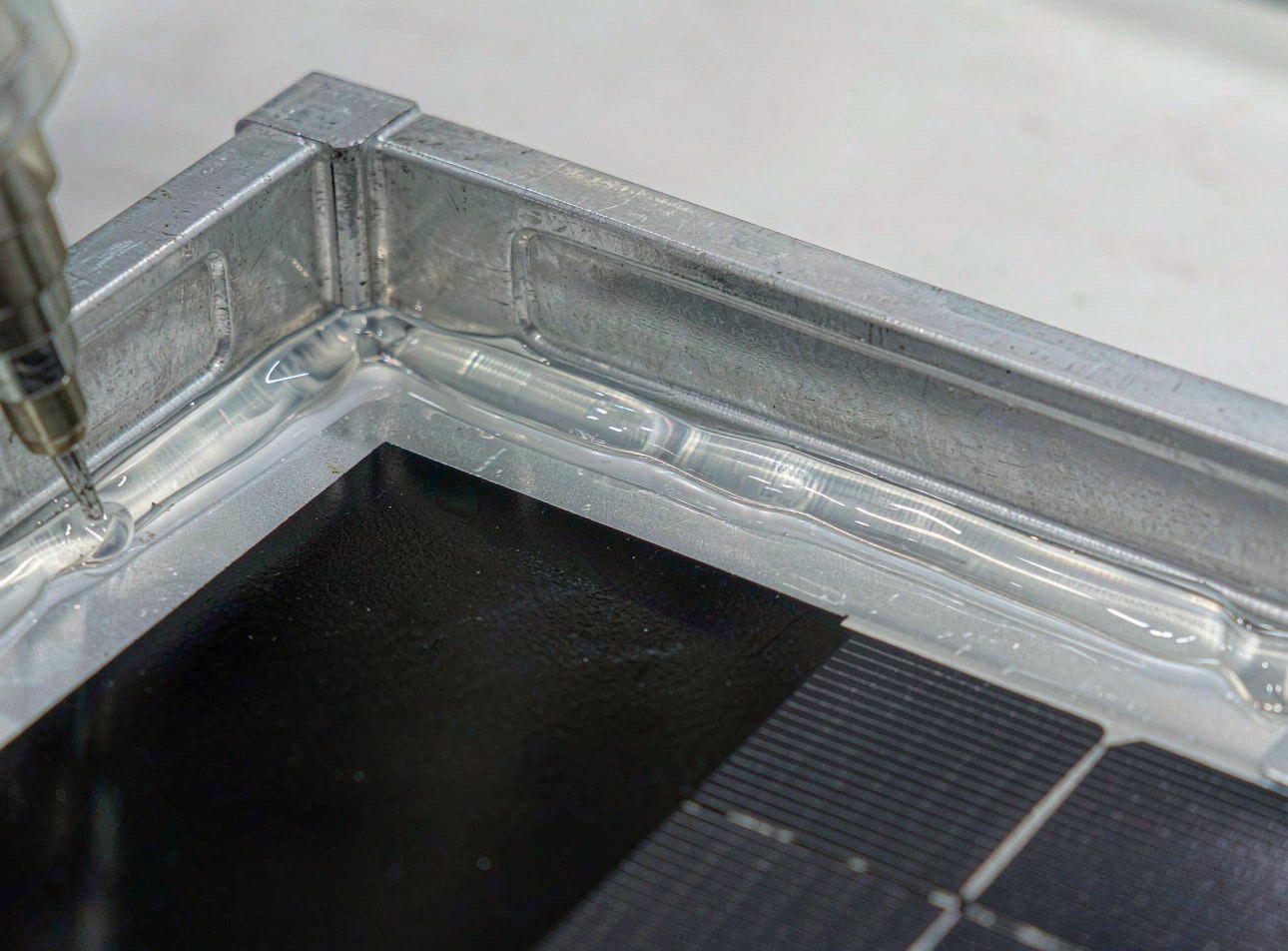
Sealant is the last line of defense in the module's water-blocking system - when it fails, the entire module loses protection
Silicone structural sealant carries three duties for the module: water sealing, adhesion and stress buffering. But silicone systems have an inherent weakness: siloxane bonds degrade slowly under long-term UV and damp heat, showing up as surface chalking and declining adhesion strength, and ultimately causing debonding and water ingress. This is a high-share category in field-failure complaints for PV modules.
I. Mechanism and path of sealant failure
Sealant ageing starts at the surface: UV across 280-400 nm breaks the silicone chain, then moisture and acid work inward.
Silicone sealant aging is a classic starts at the surface, progresses inward process:
- UV-initiated chain scission: 280-400 nm UV breaks the siloxane backbone, first generating hydroxyl groups and low-molecular-weight siloxanes at the surface;
- Oxidation and crosslinking together: the small fragments produced by scission react with air to form a network structure, appearing as a surface chalk layer (chalking);
- Adhesion-interface degradation: the chalk layer thickens continuously and peel strength declines linearly;
- Water-blocking failure: once adhesion is lost, moisture and ions penetrate along the interface, triggering corrosion and PID, and ultimately module failure.
II. Tiangang's liquid HALS solution
Compared with powder HALS, liquid HALS has clear advantages in silicone systems: it can be pre-blended directly into the silicone sealant base, disperses evenly, and does not settle or agglomerate in low-viscosity systems the way powders do.
Tiangang® HS-508 (HALS 292)
Liquid high-efficiency hindered-amine light stabilizer. Used together with benzotriazole UVAs it shows good synergy and can markedly improve the weather resistance of the finished part. With a suitable dispersant it adapts well to water-based systems. Particularly suited to automotive coatings, automotive refinish coatings, wood coatings and industrial coatings, preventing surface cracking and gloss loss.
UV-531 / UV-P
Benzophenone-type UV absorber, in liquid form, with good compatibility with silicone/PVC systems - suited to liquid formulation systems.
HS-788 blended additive package
Oligomeric HALS synergistic mixture, with light stabilization and antioxidation in synergy, staged interception of aging, dual protection in processing and service, and easier pre-blended formulation - suited to PV customers who prefer not to compound in-house.
III. Formulation matrix by part
Module frame sealants use UV-531 or UV-P together with the liquid HALS HS-508 in a silicone or MS adhesive.
| Application site | System | Recommended solution | Function |
|---|---|---|---|
| Module frame sealant | Silicone / MS adhesive | UV-531 or UV-P + liquid HALS (HS-508) | Suppresses surface chalking, maintains adhesion strength and water-blocking performance |
| Backsheet-to-frame bonding | Structural adhesive | UV-326 / UV-328 + HS-944 | Interface weather resistance and long-term adhesion retention |
| Junction-box potting compound | Epoxy / silicone | UV-531 + AO-1010 | Suppresses interface degradation under outdoor exposure |
| Mounting surface coating | Powder coating / paint | UV-531 + UV-770 + AO-B225 | Long-term outdoor weather resistance, color retention and mechanical-property retention |
| Module frame coating | Metal coating | Liquid HALS + UVA synergy | Improves coating weather resistance, delays chalking |
IV. Tiangang's extended capabilities in coatings and weather resistance
Benzotriazoles (UV-326/UV-328) have lighter color and suit color-sensitive applications.
It should be noted that sealants and coatings are not exclusive to PV. Tiangang has mature positions in coatings, plastics, automotive, textiles, agricultural film and rotational molding, and the weather-resistance formulation experience accumulated in these fields transfers directly to PV sealing and coating steps.
T-66 agricultural-film light stabilizer
agricultural-film light-stabilizer package for pesticide resistance, developed for the harsh acid-rain, pesticide and herbicide environment of agricultural film. This acid-resistant formulation thinking is equally valuable for long-term outdoor exposure scenarios.
T-78 automotive light stabilizer
automotive-modified light-stabilizer package, meeting long-cycle weather-resistance and low-bloom requirements. The automotive industry's stringent standards for bloom and fogging align closely with PV's requirements on migration and bloom.
HS-508 / HS-630 coating light stabilizers
dedicated liquid and powder light stabilizers for coatings, preventing surface cracking, discoloration and gloss loss.
Q: How to choose between liquid and powder HALS in sealants?
A: Silicone sealants are low-viscosity systems; powder HALS disperses unevenly and settles, so liquid HALS has the dispersion advantage. Where the system is more viscous (e.g. structural adhesives), powder HALS may offer better cost performance - it depends on the process.
Q: UV-531 is a benzophenone - are there any issues?
A: Benzophenone absorbers can introduce slight color deviation under certain conditions, so appearance confirmation is needed for light-colored or transparent systems.
Q: Can Tiangang develop custom formulations for PV sealants?
A: Yes. Given the large differences between manufacturers' silicone systems, crosslinker formulations and processes, send us the base system, the main failure symptoms and the target life class, and the technical team will design the formulation and provide validation support.
Sealant failure is usually gradual and hidden; by the time it shows in the field it is too late to recover. If your concern is long-term module reliability, send us the sealant base system and current formulation, and the Tiangang technical team can help assess the room for weather-resistance improvement.
Contact the Tiangang technical team →- None
- None
Certifications
- National High-Tech Enterprise
- Vice Chairman Unit, China Plastics Processing Industry Association (CPPIA)
- Vice Chairman Unit, Agricultural Plastics Branch, China Agricultural Plastics Application Technology Society
- Member, Ageing Methods Subcommittee, National Technical Committee on Plastics (SAC/TC15/CS5)
- Member, Society of the Plastics Industry (SPI), USA
Recommended Products
Products
UV Absorbers
400-094-4362
- Tiangang elected Executive Deputy Director Unit of CPPIA Agricultural Film Committee
- Tiangang wins Leading Award at Beijing TV Innovation Institute finals
- Tiangang concludes CHINAPLAS 2023 on a high note
- First industry-academia-research base in Weishanzhuang Town lands at Tiangang
- Tiangang-Tinaco BUCT scholarship award ceremony 2021-2022
Share the substrate, processing conditions and target service life to save a round of back-and-forth.
Start an inquiry 400-094-4362