
Encapsulant Film (EVA / POE): Yellowing, PID and UVA+HALS Synergy
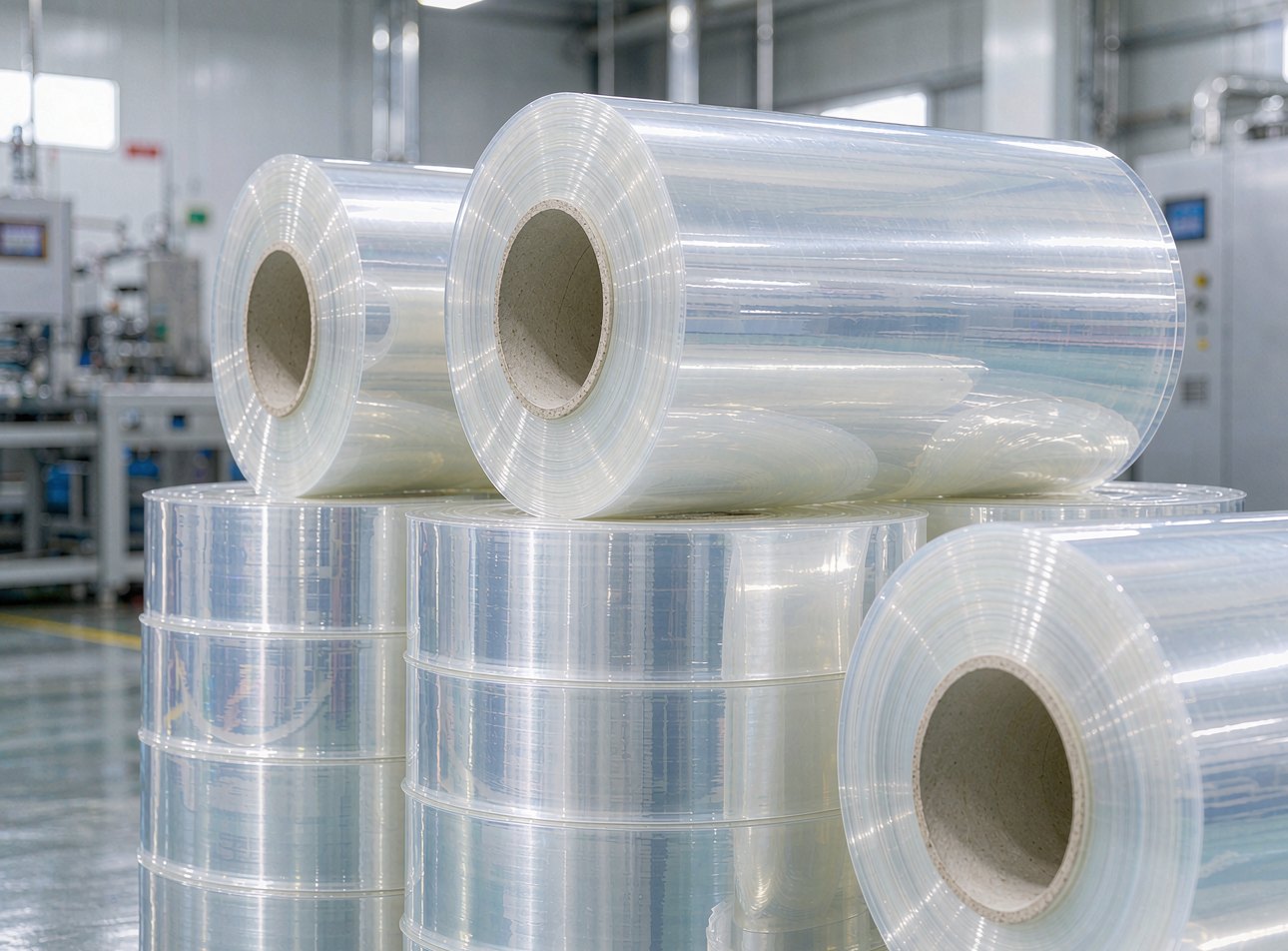
Encapsulant film is the material stage with the largest additive loading and the most demanding validation - it must simultaneously withstand UV, high temperature, high humidity and the module's working electric field
Encapsulant film accounts for roughly 2-4% of module BOM cost, yet it determines the only physical barrier between the cells and the outside environment. Over its 25-year life it must simultaneously deliver: low water-vapor transmission (WVTR), no yellowing, no delamination and no conductivity. And once module operating voltage rises above 1500 V, the film must also take on resistance to PID.
I. Three failure paths of the encapsulant film
Three failure paths dominate: yellowing, delamination and PID, all driven by 290-400 nm UV plus residual VA groups.
| Failure mode | Mechanism | Appearance and consequence |
|---|---|---|
| Yellowing (rising ΔYI) | Photo-oxidation of EVA generates yellow quinonoid products; residual VA and acidic by-products further catalyze degradation under UV | The film yellows overall, transmittance drops and module power degrades; in severe cases the cells themselves are stained |
| PID (potential-induced degradation) | The high electric field between the positive and negative poles (DC 1500 V+) drives carriers to the passivation-layer interface of the cell, weakening passivation | Fill factor and open-circuit voltage drop, with non-linear power decay; humidity accelerates the process |
| Delamination / bubbles | Residual acetic acid and degradation products accumulate at the interface and become chemically incompatible with the adhesive layer | Inter-layer peeling and blistering; fails the IEC 61215 damp-heat test |
II. Why UVA and HALS must be combined
A UVA absorbs one photon and is consumed, while HALS regenerates; over 290-400 nm the two must be paired.
This is the most central - and most often oversimplified - principle in encapsulant formulation. To understand it, note that the two additive types act at different positions:
Benzotriazole UVAs: single-pass consumption
After absorbing 290-400 nm UV they form quinonoid intermediates, one molecule absorbs only once, and are then consumed. They intercept photons at the periphery of the system, but have an upper limit on effective lifetime.
Hindered-amine HALS: cyclic regeneration
They terminate excited-state hydrocarbons through quenching and act as hydrogen donors in a regeneration loop, with no net consumption of themselves, so in theory they can protect for the full service life.
The key point: the UV energy absorbed by UVA is released as heat, which in turn protects the HALS chromophore from photolysis. Conversely, the hydroxylamines and nitroxyl radicals generated by HALS can regenerate the consumed UVA chromophore, delaying its failure. The two protect different targets and are consumed differently - one is single-pass, the other cyclic - so they must be combined to cover the full life cycle.
III. Tiangang's recommended formulations
Plan A for EVA encapsulant film: UV-326 or UV-328 at 0.3-0.8 phr together with a HALS.
Plan A | EVA encapsulant film (general weather resistance)
| Component | Recommended product | Reference loading | Function |
|---|---|---|---|
| UV absorber | UV-326 / UV-328 | 0.3 – 0.8 phr | Intercepts UV, reduces photoinitiation |
| High-molecular-weight HALS | Tiangang® HS-944 | 0.2 – 0.6 phr | Excited-state quenching, long-term protection |
| BW-10LD (HALS 622) | 0.2 – 0.5 phr | Polymeric, high molecular weight, low migration | |
| Primary antioxidant | Tiangang® AO-1010 | 0.1 – 0.3 phr | Traps free radicals; the primary line of defense |
| Secondary antioxidant | Tiangang® AO-168 | 0.1 – 0.3 phr | Decomposes hydroperoxides |
| AO-B215 (1010+168 pre-blend) | 0.3 – 0.8 phr | All-in-one, fewer compounding steps |
Plan B | POE encapsulant film (ion control first)
POE film performs very well on PID resistance and moisture barrier, but is extremely sensitive to ionic and metal-ion impurities. Additives used in the formulation must therefore be inherently low in ionic and metal-ion content, to avoid introducing new PID drivers.
| Component | Recommended product | Why this product |
|---|---|---|
| UV absorber | UV-234 (triazine) / UV-360 | The triazine structure is more acid- and alkali-resistant and compatible with POE |
| HALS | HS-944 / BW-10LD | High molecular weight and non-migrating; avoids interfacial blooming that would compromise adhesion |
| Antioxidant | AO-1010 + AO-168 | Controls oxidative degradation introduced by the thermal history |
| Anti-PID synergy | Pair with low-ion flame-retardant grades | Avoid introducing metal-ion and anionic impurities |
IV. The EVA-to-POE shift: industry trend and response
Driven by rising bifacial-module penetration and PID failure cases, POE/EVA hybrid encapsulant systems are becoming the mainstream direction. This brings a key formulation-level shift:
- from pursuing weather resistance to pursuing ion purity - the metal-ion content and ash of additives become an entry threshold;
- from single components to synergistic systems - UVA, HALS, antioxidants and ion scavengers must all be present;
- from short-cycle validation to full-life-cycle demonstration - accelerated tests such as damp heat 85°C/85%RH per IEC 62788 become mandatory;
If you are developing or optimizing a PV encapsulant formulation, send us the resin system (EVA grade / POE supplier), the ratio, the processing temperature and the target validation items (yellowing level, PID damp-heat duration). The Tiangang technical team will provide the matching additive package and validation support.
Contact the Tiangang technical team →- None
- None
Certifications
- National High-Tech Enterprise
- Vice Chairman Unit, China Plastics Processing Industry Association (CPPIA)
- Vice Chairman Unit, Agricultural Plastics Branch, China Agricultural Plastics Application Technology Society
- Member, Ageing Methods Subcommittee, National Technical Committee on Plastics (SAC/TC15/CS5)
- Member, Society of the Plastics Industry (SPI), USA
Recommended Products
Products
UV Absorbers
400-094-4362
- Tiangang elected Executive Deputy Director Unit of CPPIA Agricultural Film Committee
- Tiangang wins Leading Award at Beijing TV Innovation Institute finals
- Tiangang concludes CHINAPLAS 2023 on a high note
- First industry-academia-research base in Weishanzhuang Town lands at Tiangang
- Tiangang-Tinaco BUCT scholarship award ceremony 2021-2022
Share the substrate, processing conditions and target service life to save a round of back-and-forth.
Start an inquiry 400-094-4362