
Module Backsheet (PET / Fluorinated): UV Resistance, Hydrolysis Resistance and the Fluorine-Free Route
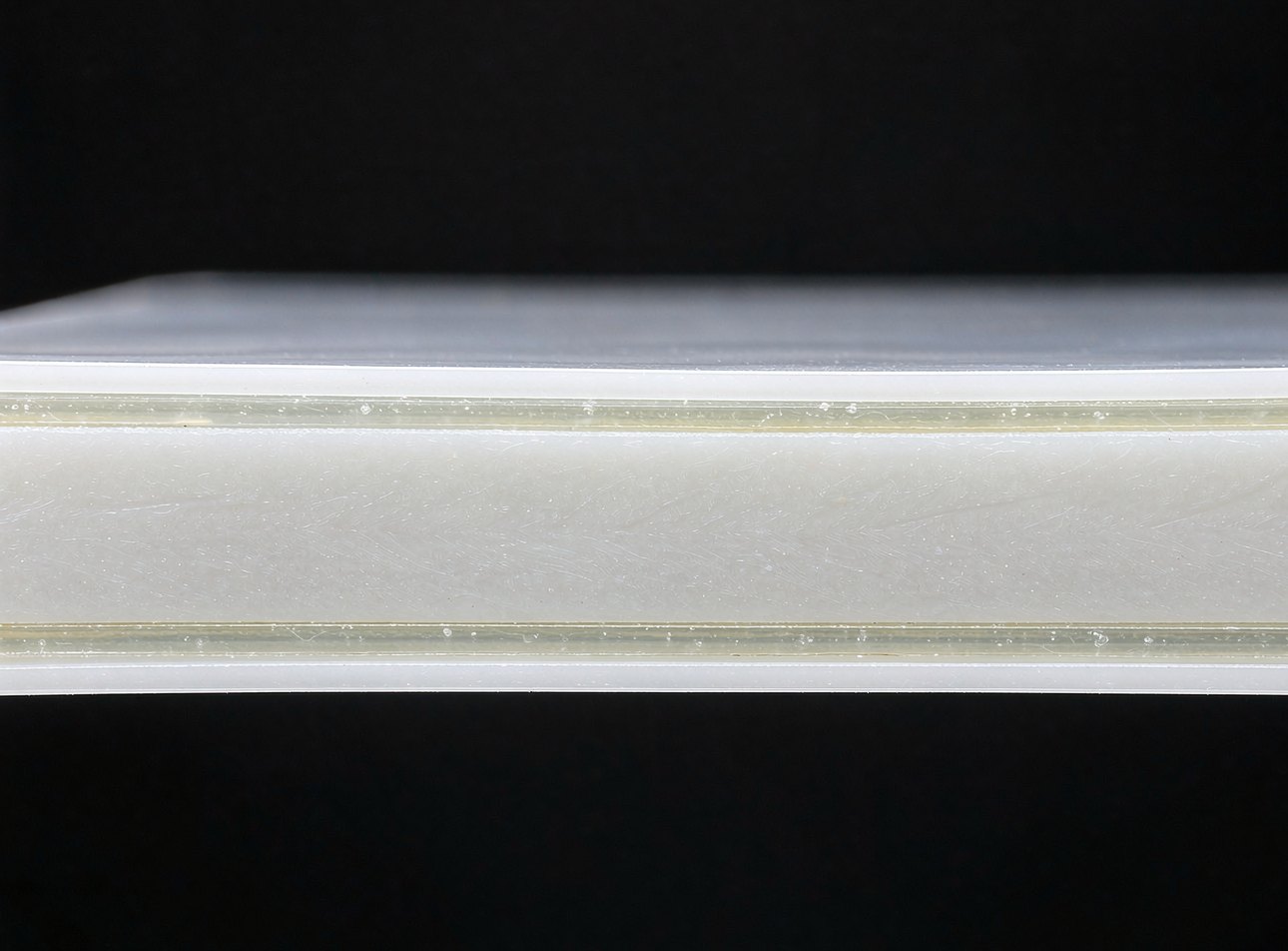
The backsheet is the outermost layer facing UV, moisture and mechanical stress; its stability sets the module's long-term reliability class
The backsheet accounts for less than 0.5% of module BOM cost, yet it decides whether the module passes TUV certification and the IEC 61215 / IEC 61730 aging tests. This is a classic low-cost, high-responsibility component - a cracked or delaminated backsheet usually means failure of the entire module.
I. Backsheet architecture and material interfaces
A mainstream backsheet is a 3- or 5-layer co-extrusion, and the outer fluoropolymer layer carries the UV load.
Mainstream backsheets are three- or five-layer co-extruded composite structures. Understanding each layer's material characteristics is the precondition for choosing the right additives:
| Layer | Typical material | Main function | Aging concerns |
|---|---|---|---|
| Outer layer | Fluoropolymer resin (PVDF) / anti-UV co-extrusion layer | UV resistance, weather resistance, chemical-media resistance | Long-term outdoor UV aging, chalking, cracking |
| Adhesive layer | Copolyamide-type adhesives | Inter-layer bonding | Interfacial hydrolysis, compatibility with adjacent layers |
| Core layer | PET (polyester film) | Primary mechanical support, moisture barrier | Hydrolysis resistance, strength retention |
| Inner layer | POE / EVA co-extrusion layer | Bonding interface with the encapsulant film | Ion content, compatibility with the encapsulant |
II. Additive differences between the fluorinated and fluorine-free routes
Driven by both regulation and cost, fluorinated backsheets are evolving toward fluorine-free and low-fluorine routes. The two routes differ markedly in additive requirements:
| Dimension | Fluorinated route (PVDF face layer) | Fluorine-free / low-fluorine route (anti-UV co-extrusion) |
|---|---|---|
| Face-layer weather resistance | Carried mainly by the PVDF itself | Highly dependent on the additive system |
| Anti-UV requirement | Supplementary - slows face-layer aging | Critical - UVA carries the primary protection |
| HALS requirement | Moderate - suppresses deep oxidation | High - carries long-cycle protection |
| Antioxidant requirement | PET core-layer hydrolysis dominates; antioxidants play a supporting role | High - antioxidants determine core-layer life |
In short: the fluorinated route assigns weather resistance to the face-layer material; the fluorine-free route must close that gap with the additive system. This is also the root cause of why additive loading and technical importance rise together in the fluorine-free transition.
III. Tiangang's recommended formulations
The anti-UV face layer takes UV-326 or UV-328 at 0.5-1.5 phr, covering the full 290-400 nm band.
| Application layer | Recommended product | Reference loading | Notes |
|---|---|---|---|
| Anti-UV face layer / co-extrusion layer | UV-326 / UV-328 | 0.5 – 1.5 phr | Benzotriazole, full 290-400 nm coverage |
| UV-234 (triazine) | 0.5 – 1.5 phr | Acid- and alkali-resistant; suits coexistence with the adhesive layer | |
| PET core-layer hydrolysis resistance | AO-1010 | 0.3 – 1.0 phr | Slows polyester hydrolysis, maintains strength retention |
| AO-1076 | 0.2 – 0.6 phr | Liquid, easy to disperse; suits impregnation or coating processes | |
| Long-cycle weather resistance | HS-944 / BW-10LD | 0.2 – 0.8 phr | High-molecular-weight HALS, low migration, no blooming |
| Functional masterbatch option | MB570-20PET | Calculated on the masterbatch | Designed specifically for PET substrates, with excellent dispersibility |
IV. TUV backsheet certification focus points
Tiangang® MB570-20PET is an anti-UV functional masterbatch developed specifically for PET substrates.
For TUV backsheet certification, the following items are directly tied to the additive formulation and worth preparing in advance:
| Test item | What is assessed | Formulation-related risk points |
|---|---|---|
| UV preconditioning (IEC 61215 MQT 10) | Material performance retention after UV exposure | Insufficient UVA - strength retention and transmittance miss the target |
| damp heat 85/85 (MQT 13) | Insulation and mechanical retention under damp heat | Insufficient antioxidant - accelerated PET hydrolysis, declining insulation performance |
| Mechanical load test (MQT 01) | Integrity after installation and wind load | Embrittlement after aging leads to cracking; insufficient HALS accelerates degradation |
Q: Does Tiangang offer a functional masterbatch specifically for PET?
A: Yes.adapted to PET's processing temperature and dispersion characteristics. It markedly reduces the problem of uneven dispersion in high-viscosity PET systems, which causes insufficient effective additive concentration.
Q: Do fluorinated backsheets still need a UV absorber?
A: Yes, but the role differs. The PVDF face layer carries the primary protection; additives serve to protect the PET core layer and inter-layer interfaces and to slow the aging of the face layer itself. They are supplementary rather than critical, but still need to be included in long-term reliability demonstrations.
Q: Can backsheet formulations use liquid additives?
A: Liquid grades such as AO-1076 disperse better than powders in coating and impregnation processes and suit enhancement processes where the PET surface is impregnated. Tiangang also offers liquid HALS grades.
If you are upgrading a backsheet formulation - especially moving from fluorinated to fluorine-free, or addressing the UV and damp-heat items for TUV certification - send us the layer structure, layer materials and film thicknesses. The Tiangang technical team will provide targeted additive recommendations.
Contact the Tiangang technical team →- None
- None
Certifications
- National High-Tech Enterprise
- Vice Chairman Unit, China Plastics Processing Industry Association (CPPIA)
- Vice Chairman Unit, Agricultural Plastics Branch, China Agricultural Plastics Application Technology Society
- Member, Ageing Methods Subcommittee, National Technical Committee on Plastics (SAC/TC15/CS5)
- Member, Society of the Plastics Industry (SPI), USA
Recommended Products
Products
UV Absorbers
400-094-4362
- Tiangang elected Executive Deputy Director Unit of CPPIA Agricultural Film Committee
- Tiangang wins Leading Award at Beijing TV Innovation Institute finals
- Tiangang concludes CHINAPLAS 2023 on a high note
- First industry-academia-research base in Weishanzhuang Town lands at Tiangang
- Tiangang-Tinaco BUCT scholarship award ceremony 2021-2022
Share the substrate, processing conditions and target service life to save a round of back-and-forth.
Start an inquiry 400-094-4362