Topic 04: Additive Solutions for Televisions and Smart Terminals
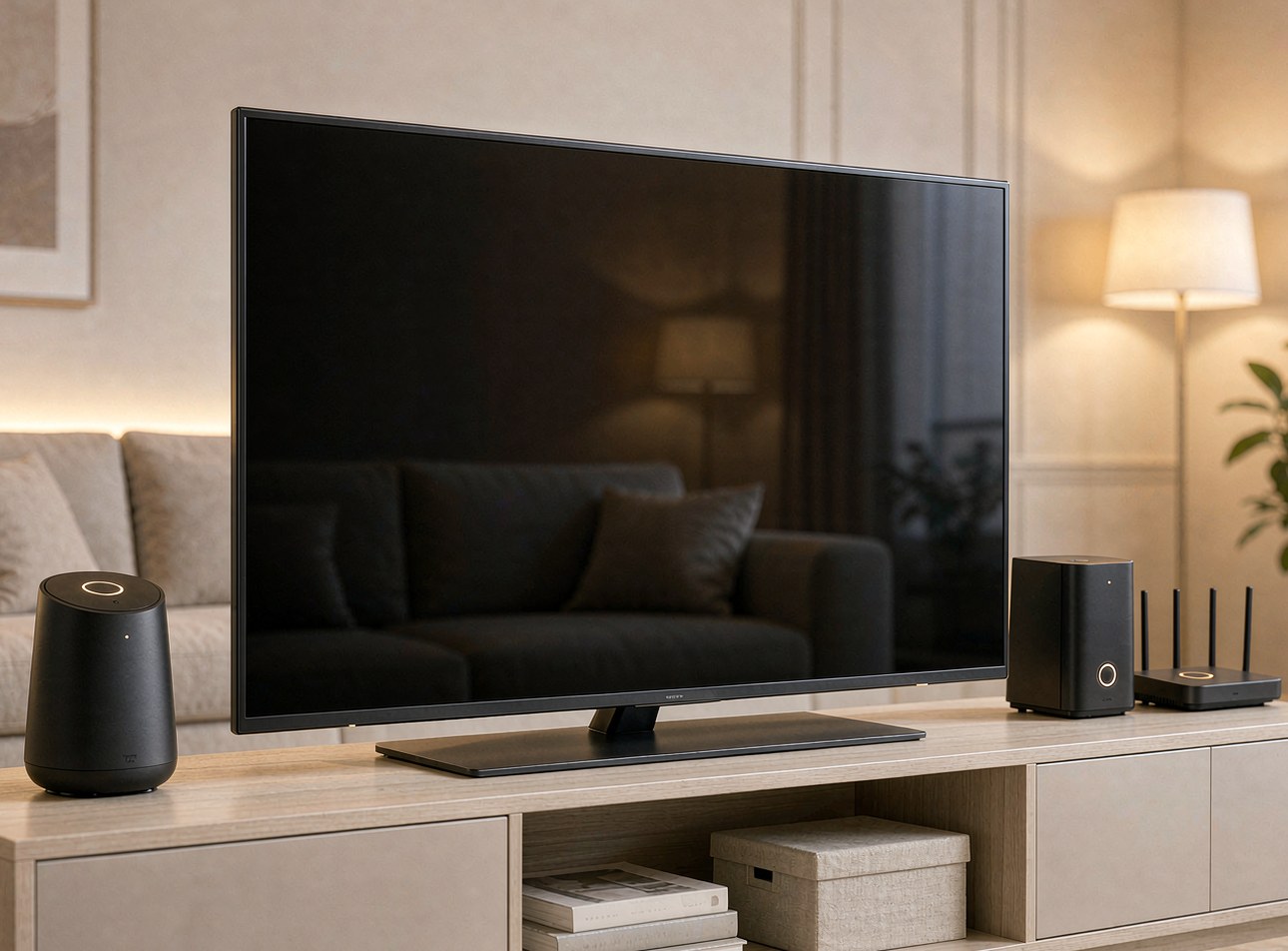
Topic 04 · Televisions and Smart Terminals (Brown Goods)
1. What makes brown-goods plastic parts special
1.1 Long-term indoor light exposure ≠ no aging
Many people believe "indoor parts do not need light stabilizers" - a widespread misconception. TV back covers and stands often sit right against the display module and power board, in a sustained local high-temperature environment of 40-60°C; at the same time, although the UV in household lighting is weaker than outdoors, the cumulative dose over an 8-10 year service life is not low.The coupled action of heat + light makes light-colored ABS back covers yellow noticeably within 3-5 years - for modern TVs sold on "maximum screen-to-body ratio", this is a fatal perception problem.
1.2 Flame retardancy is a hard threshold
TV back covers, power boxes, remote-control housings and similar parts generally require flame retardancy of V-1 or above. Unmodified ABS reaches only HB or V-2, dripping during combustion and possibly igniting the degreased cotton below.The back cover is a classic part under the triple constraint of "flame retardancy + weather resistance + light color".
1.3 Paint-free appearance is extremely shade-sensitive
High-end TVs and smart terminals widely use paint-free PC/ABS in metallic silver, pearlescent and matte space-gray finishes.The shade-control window for such systems is extremely narrow - initial shade differences from additives, shade drift during storage and interactions with pearlescent powder can all scrap whole batches of appearance parts. This is the first requirement brown-goods customers most often raise when selecting additives.
2. Brown-goods component conditions and risks
| Component | Common substrate | Service environment | Main risks | Flame retardancy |
|---|---|---|---|---|
| Back cover | ABS / PC-ABS | Sustained 40-60°C + indoor light | Yellowing, warping, gloss loss | V-1~V-0 |
| Stand / legs | ABS / PC-ABS / metal composite | Load-bearing + indoor light + detergents | Stress cracking, shade difference | V-1 |
| Bezel / edging | Paint-free PC-ABS | Long-term indoor light + frequent touching | Shade difference, frost | V-1 |
| Remote-control housing | ABS / PC | Handheld + grease + indoor light | Tacky surface, yellowing | V-2 |
| Power box / junction box | ABS / PA | High temperature + electrical safety | Thermo-oxidative aging, flame-retardancy failure | V-0 |
| Smart control-screen panel | Paint-free PC-ABS | Long-term light + touch grease | Shade difference, surface hazing | V-1 |
3. Tiangang's recommended formulations for brown goods
The following are starting points (by weight). Light-colored and paint-free systems need particular control of initial color; we recommend confirming shade difference on small samples first.
| Component / scenario | Tiangang recommendation | Effective loading | Why this one |
|---|---|---|---|
| Front frame / middle frame Paint-free PC-ABS, light colors |
T-81 Dedicated pre-blended package for modified materials |
Feed 0.5% - 0.8% | 50%±2.5% concentration, carrier MFI>10, rheologically matched to PC-ABS modified pellets; inter-batch appearance consistency comes from a "fixed formulation", not from "trial compounding every time" |
| Back cover / stand PP / ABS, black or dark colors |
T-70 | Feed 0.6% - 0.9% | Dark parts are insensitive to initial color but sensitive to long-term thermal stability; the pre-blended package covers both the processing and use stages |
| Power module housing Temperature-resistant 85°C+, flame retardancy required |
FR-810A + HS-300 | FR-810A 0.5% – 1.0% HS-300 0.15% – 0.25% |
FR-810A's three effects in one already provide long-term thermal stability, so HS-300 is only needed in small amounts to cover the UV segment (high effective nitrogen, effective from 0.1%), with no need for a separate complete HALS system |
| Internal bracket / air duct Glass-fiber reinforced PP |
HS-962 or T-70 | HS-962 0.4% – 0.6% T-70 feed 0.6% |
For glass-fiber systems, granular blended packages disperse better than powders; HS-962 suits both thick and thin products, making it easy to unify material codes across the line |
| Light-colored panel / decorative parts Most shade-sensitive |
HS-362 + AO-427 | HS-362 0.4% – 0.6% AO-427 0.2% – 0.3% |
HS-362 has a softening point of 105-120°C and Mn>2000, with stable dispersion and initial color performance; AO-427 improves dyeing performance, serving shade control directly - light transmittance @500nm ≥92%, friendly to light-colored systems |
| Remote control / key parts ABS, long-term hand contact |
HS-330 | 0.3% – 0.5% | Low volatility and migration, extraction resistant; hand-contact parts are most sensitive to surface blooming and odor, where the Me-HALS structure outperforms easily migrating low-molecular-weight grades |
| Whole-product housings for export models High temperature and humidity + RoHS |
T-78 + XT-8 | T-78 feed 0.6% - 1.0% XT-8 0.15% |
T-78 covers general weather resistance, while XT-8's NOR structure handles acidic environments under high temperature and humidity; REACH / TSCA registration documentation complete |
4. Key control points for brown-goods appearance consistency
4.1 Managing additive initial color
- Select proprietary low-color-development grades: the low color development and initial-color performance of proprietary grades such as HS-362, HS-962 and HS-330 are validated, suiting light-colored and pearlescent systems; HS-9611 and HS-200 are also rated for low color development and can be switched by substrate
- Fix the color base with a blended package first:The root cause of inter-batch shade differences is formulation fine-tuning. With pre-blended packages such as T-81 / T-70, the color base is fixed by Tiangang at the factory end - far more stable than fine-tuning the HALS-to-UV-A ratio batch by batch
- Add AO-427 to dyed systems: its dyeing-performance improvement directly improves masterbatch dispersion uniformity, with practical effect on shade control of light-colored parts
- Batch management: for light-colored appearance parts, we recommend agreeing with the additive supplier on inter-batch shade difference ΔE ≤ 0.5, and adding shade sampling to incoming inspection
4.2 Preventing frost (blooming)
The white haze on paint-free part surfaces mostly comes from surface migration of low-molecular-weight additives during processing or storage. Prevention points:① Prefer high-molecular-weight polymeric HALS;② Avoid extended residence at high temperature (barrel temperature not exceeding 250°C);③ Control additive-resin compatibility, adding a dispersant where necessary;④ Avoid high-temperature, high-humidity storage of finished products.
4.3 Special handling of pearlescent and metallic systems
Pearlescent powder, mica and metallic-effect masterbatches have large specific surface areas, physically adsorbing additive molecules, lowering local effective concentration. Countermeasures:increase the HALS loading by 20-30%, or switch to higher-molecular-weight grades that adsorb less on pigment surfaces; confirm the actual effect through joint shade and weather-resistance validation.
5. Recommended validation indicators
| Indicator | Test standard | Recommended value | Notes |
|---|---|---|---|
| Artificial accelerated aging | GB/T 16422.2 (QUV) | No significant powdering at 2000 h | Adding thermal-aging overlay conditions brings it closer to reality |
| Thermo-oxidative aging | GB/T 5510 (hot-air aging) | Shade difference ≤ 2 at 85°C × 168 h | Simulates the local high temperature of the back cover |
| Shade difference | GB/T 11944 (ΔE) | ΔE ≤ 1.5 | Can be tightened further to 1.0 for light-colored parts |
| Gloss retention | GB/T 8807 (60°) | ≥ 85% | ≥ 90% recommended for paint-free parts |
| Flame-retardancy rating | ANSI/UL 94 (1.6 mm) | V-0 / V-1 as required | Must be confirmed by testing; cannot be inferred from loading alone |
| Surface blooming | Visual / wipe | No frost, no blooming | Mandatory for paint-free parts |
Are shade problems on brown-goods appearance parts troubling your production?
Tiangang offers small-sample shade confirmation based on the customer's actual masterbatch system, minimizing risk before the formulation is finalized.
Contact us · 400-094-4362Certifications
- National High-Tech Enterprise
- Vice Chairman Unit, China Plastics Processing Industry Association (CPPIA)
- Vice Chairman Unit, Agricultural Plastics Branch, China Agricultural Plastics Application Technology Society
- Member, Ageing Methods Subcommittee, National Technical Committee on Plastics (SAC/TC15/CS5)
- Member, Society of the Plastics Industry (SPI), USA
Recommended Products
Products
UV Absorbers

- Tiangang elected Executive Deputy Director Unit of CPPIA Agricultural Film Committee
- Tiangang wins Leading Award at Beijing TV Innovation Institute finals
- Tiangang concludes CHINAPLAS 2023 on a high note
- First industry-academia-research base in Weishanzhuang Town lands at Tiangang
- Tiangang-Tinaco BUCT scholarship award ceremony 2021-2022