Artificial Turf Weathering Solutions: Light Stabilizers, Antioxidants and Flame Retardants
01The Core Problem: Flame Retardancy and Weatherability Fight Each Other
Artificial turf fails in two ways. The grass fibre fades and becomes brittle under UV exposure. Or it passes the flame retardancy test but loses its outdoor life because the retardant consumed the light stabiliser. Most formulators discover the second problem only after they have already qualified the first.
This is not a formulation mistake. It is a chemical incompatibility that runs deeper than most product datasheets admit. Understanding it is the single most valuable thing a technical buyer can do before writing a specification.
Where the conflict actually starts
A halogenated flame retardant and a hindered amine light stabiliser (HALS) do not coexist neutrally in the same polymer. Brominated retardants thermally or photolytically decompose, releasing HBr and bromide species. Those protonate the basic nitrogen of an N-H type HALS, and the stabiliser is neutralised.
2. HBr / Br− protonates the N-H type hindered amine
3. The HALS is neutralised and can no longer scavenge free radicals
4. Net result: flame retardancy passes, weathering fails prematurely
Phosphorus-based retardants are less aggressive but their degradation products still consume hindered amines. Industry patent literature documents this conflict explicitly. The usual workaround is to switch to a lower-basicity HALS, which helps but does not eliminate the problem.
Three things that make it harder
- Rubber infill is an acid reservoir. Vulcanisation residues and stearic acid in filled systems continuously consume basic stabilisers from day one. Filled turf is a different formulation problem from unfilled turf.
- Outdoor exposure is unforgiving. UV, moisture, thermal cycling and acidic rainfall act together. A stabiliser that performs in a laboratory ageing chamber can still underperform on a coastal pitch in a high-UV climate zone.
- Export compliance narrows your options. RoHS 2.0 restricts PBB and PBDE; REACH lists HBCDD under POPs; and many European buyers impose halogen limits beyond the legal minimum. Formulating for one market can lock you out of another.
02How Artificial Turf Ages: Four Simultaneous Pathways
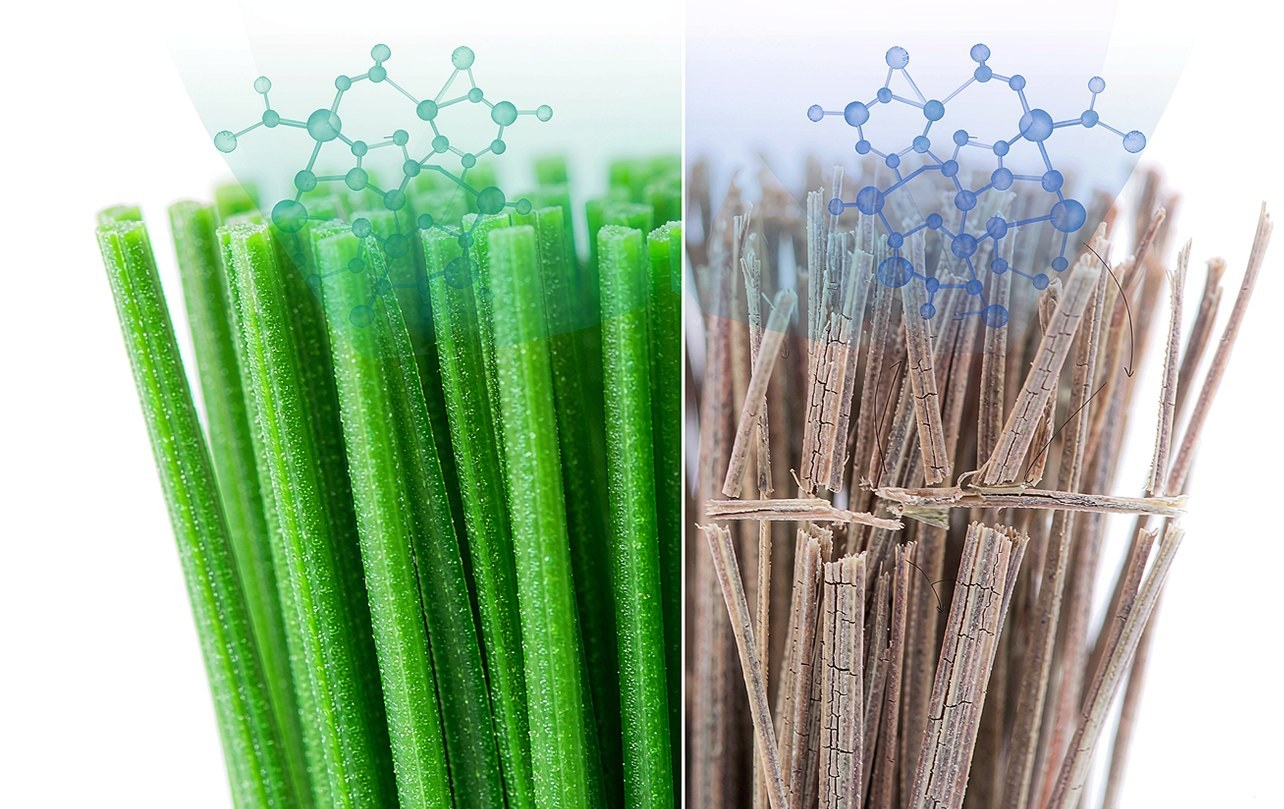
UV degradation is not a single reaction. It is four coupled pathways, and a complete stabilisation system has to interrupt each one. Most under-specified formulas cover only the first, which is why they disappoint in the field.
| Stage | Chemical process | Counter-measure | Representative chemistry |
|---|---|---|---|
| 1. Initiation | UV-B photons cleave PE / PP chains, generating alkyl macroradicals R· | Absorb UV energy and reduce initiation efficiency | UV-326 / UV-327 / UV-328 / UV-329 (benzotriazoles) |
| 2. Propagation | R· + O2 → ROO·, an autocatalytic chain | Scavenge active radicals and terminate the chain | HS-944, BW-10LD (622), XT-8 (HALS family) |
| 3. Degradation | ROO· → ROOH, molecular weight drops, material embrittles | Decompose hydroperoxides before they cleave further | AO-1010 / AO-B215 (hindered phenol systems) |
| 4. Catalysis | ROOH decomposition generates acidic products that catalyse neighbouring degradation | Chelate transition metals and suppress catalytic oxidation | AO-168 / AO-DSTDP (phosphite systems) |
03The Tiangang Approach: A Three-Layer Protection System
Rather than selling you a single additive, Tiangang supplies the complete protection stack — and, critically, the structural chemistry that keeps these layers from cancelling each other out.
What makes Tiangang structurally different is the third layer of this story: the company also manufactures a polymeric NOR halogen-free flame retardant. Because its flame retardancy originates from the hindered amine chemistry itself, it introduces no acidic by-products. The retardant stops fighting the stabiliser — which is exactly the problem a pure light-stabiliser supplier cannot solve and will not discuss.
04Product Matrix: Matching Chemistry to the Application
Not every application needs every layer. The table below maps the Tiangang range against the service conditions, so you can specify rather than guess. Dosing figures are relative to resin content and should be confirmed against your own accelerated ageing data.
| Tiangang product | Category | Structural feature | Best-fit application |
|---|---|---|---|
| HS-944 | HALS, N-H type | Classical, industry-volume workhorse | Unfilled systems with no retardant; maximum cost efficiency |
| BW-10LD (HS-622) | HALS, N-CH3 type | Low basicity, markedly better acid resistance | Rubber-filled turf; systems containing halogenated retardants |
| XT-8 | HALS, N-OR (NOR) type | Very low basicity; high molecular weight; acid and sulfur resistant | High-UV climates, acid rain zones, export-compliant formulations |
| HS-112 | NOR, low molecular weight liquid | Liquid, easy to disperse | Liquid dosing systems where dispersion is critical |
| FR-810A | Polymeric NOR flame retardant | True polymer; halogen-free; three functions in one molecule | Export-bound turf requiring flame retardancy and weathering resistance |
| AO-1010 | Hindered phenol AO | Primary antioxidant, hydroperoxide decomposition | Universal base of any stabilisation package |
| AO-168 | Phosphite AO | Metal chelation, long-term thermal stability | Pairs with AO-1010 to cover stage 4 of oxidation |
| HS-788 | Compounded light stabiliser package | Synergistic blend, ready to use | Customers who want to avoid in-house blend development |
| HS-962 | Compounded light stabiliser package | Staged interception of degradation pathways | Protection across both processing and service life |
| MB6250PP20 / MB6251PP20 | PP masterbatch | 50% active dispersion in PP carrier | Guaranteed dispersion uniformity, avoids blotchy ageing |
05Verification: From Claim to Evidence
A ten-year service life claim is only worth what the ageing data behind it says. Here is how the industry verifies turf stabilisation, and where formulations most often disappoint.
Industry-standard verification methods
| Test | Standard | Core measurement | Notes |
|---|---|---|---|
| Xenon arc weathering | ISO 4892-2 / ASTM G155 / EN 14836 | Colour difference ΔE, tensile strength retention | The dominant method for sports turf procurement |
| Fluorescent UV ageing | ASTM G154 (UV-A / UV-B) / GB/T 16422.3 | Colour fastness change, tensile retention | Fast screening of UV resistance |
| Artificial climate ageing | DIN 53384 | Performance decay under combined climate load | Commonly specified by European buyers |
| Textile colour fastness | AATCC 16.3 | Light fastness grade | Used to qualify the masterbatch supplier |
| Mechanical retention | ASTM D5034 | Breaking strength, elongation, retention ÷ | Mandatory in every scenario |
| Abrasion resistance | ISO 5470-1 / Martindale | Abrasion loss | High-wear zones such as sports pitches |
| Flame retardancy | GB 8624 / EN 13501-1 / SBI / cone calorimetry | Burning grade, HRR, char yield, smoke toxicity | Mandatory for public buildings and export |
| Restricted substances | RoHS / REACH / halogen screen / IEC 62321 | Br and Cl totals, SVHC screening | Mandatory for export |
The acceptance thresholds that matter
- Tensile strength retention ≥ 80% after accelerated ageing. This is the industry-wide gate. A good formulation leaves clear headroom above it.
- Colour difference ΔE within an agreed tolerance. Definitions vary significantly between buyers — fix the value in the specification, not after testing.
- No powdering, cracking or surface chalking at the end of the ageing cycle. These are the leading indicators of the mechanical failure that follows.
- Flame grade and smoke toxicity must both pass. Under GB 8624-2012 a formulation can meet the burning grade and still fail on CO ≤100 ppm / HCN ≤20 ppm.
- Halogen limits: Cl ≤900 ppm, Br ≤900 ppm, Cl+Br ≤1500 ppm. Note that RoHS compliance does not equal halogen compliance — halogens enter through pigments, inks, fillers and cleaning agents too.
A common mistake is treating an accelerated ageing result as a direct year-for-year conversion. Conversion factors vary widely with light source, wavelength and humidity control. The defensible method is multi-point sampling: run several irradiation levels, plot retention and ΔE against cumulative exposure, and identify the failure knee. That curve, not a single endpoint, is what supports a service-life claim.
06Why Tiangang Is a Different Kind of Supplier
Most additive suppliers sell you one layer of the protection stack and leave the compatibility problem to your formulator. A platform supplier sells you the whole stack — and takes responsibility for whether the layers work together.

Our six structural advantages
- Platform supply, not single-product supply. UV absorbers, HALS across all three structural families, antioxidants, masterbatches and a halogen-free flame retardant — from one supplier, with one technical contact.
- Structural choice within a single family. Most competitors offer one HALS and leave you to manage the consequences. Tiangang supplies N-H, N-CH3 and N-OR structures, so the acid tolerance can be specified rather than compromised.
- Proprietary NOR flame retardant technology. FR-810A is a true high-molecular-weight polymer, giving a wider processing window and superior thermal resistance than the molecular benchmark products it is specified against.
- Independent CAS registrations. XT-8 carries a China-registered CAS, with REACH and TSCA documentation available — relevant to import dossiers and customs clearance.
- Field evidence, not only lab data. Our agricultural film package carries 38-month greenhouse field trials with over 50% mechanical property retention. The methodology transfers directly to turf weathering validation.
- Compounded packages for fast adoption. HS-788 and HS-962 packages remove the need for in-house blend development, shortening the path from sample to qualified formulation.
Product positions we recommend against
Where a Tiangang-proprietary product exists, we prefer to specify it rather than offer the commodity equivalent. Our recommendation is to position commodity grades — UV-326 through UV-P, HS-944, HS-950, HS-770, AO-1010, AO-1076, AO-168 — as components within a compounded package rather than as standalone recommendations. For the flagship positions, the table below states what you gain by specifying Tiangang directly.
| Flagship | What Tiangang adds over the commodity equivalent |
|---|---|
| HS-362 | Proprietary package, Mn >2000, 10% weight loss onset above 350°C, softening range 105–120°C — a processing window commodity blends cannot match. |
| XT-8 | N-OR structure resists sulfur at 3000–7000 ppm and chlorine ≤850 ppm; 38-month field data; independent CAS; REACH and TSCA documented. |
| FR-810A | Polymeric, therefore low migration and low extraction; recommended processing ≤250°C; halogen-free; one chemistry serving all three functions. |
| AO-427 | Melting point 268–275°C, delivering heat stability and processing stability together with measurable dyeing improvement in pigmented systems. |
| HS-625 | Award-winning polymeric HALS; anti-extraction performance means it is not washed out by rain or irrigation, unlike lower molecular weight alternatives. |
| MB6250PP20 | Guaranteed active dispersion in a PP carrier, eliminating the dispersion variability that causes blotchy, uneven ageing across a pitch. |
07Recommended Configurations by Scenario
| Scenario | Configuration | Rationale |
|---|---|---|
| Non-filled turf, weathering only | HS-944 + UV-328 + AO-1010/AO-168 | Classical, cost-optimised three-layer protection for unfilled systems |
| Rubber-filled residential turf | BW-10LD (622) + UV-328 + AO-1010/AO-168 | N-CH3 structure tolerates the acidic load from rubber infill |
| Export sports turf with flame retardancy | FR-810A + HS-944 + AO-1010/AO-168 | NOR route removes the acid-base balancing exercise entirely |
| Public building, 10-year-plus specification | FR-810A + XT-8 + AO-1010/AO-168 | Dual NOR protection plus acid and sulfur resistance |
| Liquid dosing line | HS-112 (liquid NOR) + FR-810A | Low molecular weight liquid for uniform dispersion |
| High-UV or acid-rain climate zone | XT-8 or HS-962 + UV-328 + AO-1010/AO-168 | Maximum acid tolerance and regenerative radical scavenging |
| Fast qualification, minimal in-house R&D | HS-788 or HS-962 package | Pre-compounded, removes blend development from the critical path |
| Dispersion-critical, thin-walled products | MB6250PP20 masterbatch | Masterbatch dosing guarantees uniformity and avoids spotty ageing |
08Common Questions
Why did our turf fade even though we added a UV absorber?
Most likely because a UV absorber only intercepts stage 1 of a four-stage degradation cascade. The radical chain propagation in stage 2 continues regardless, and it is stage 2 that a HALS exists to break. Adding a benzotriazole without a HALS buys you limited time, not a service life.
We already specified a low-bascosity HALS. Is that not enough?
It reduces the rate of consumption, which is genuinely valuable, but it does not eliminate the reaction. Under strong acid load or elevated processing temperature a measurable fraction is still lost. Where the acid load is structural rather than incidental — filled turf, or a halogenated retardant in the same formulation — an N-OR structure or a NOR-based halogen-free retardant removes the acid source instead of mitigating it.
Is RoHS compliance sufficient for European export?
No, and this catches exporters out regularly. Halogens can be introduced through polymer pigments, inks, colour concentrates, fillers and cleaning agents, none of which are covered by RoHS. Several European buyers impose the four-element halogen screen (Cl, Br, Cl+Br) as a contractual requirement independent of legislation. Screen at incoming goods, not at final inspection.
Can we avoid running our own ageing programme?
You can outsource the testing, but not the specification. Define your target standard (EN 14836, GB 8624 or your own acceptance criteria) and the target service life before screening additives, then run graded ageing against that standard. Tiangang supplies samples, masterbatch compounds and formulation guidance, and will help interpret third-party reports — but the acceptance criteria should be fixed in the specification at the start.
Do you offer masterbatch grades for easier dosing?
Yes. MB6250PP20 and MB6251PP20 are PP-based light stabiliser masterbatches, MB0607 series combine active HALS with antioxidant, and TGUVFQ2001PE is specified for thick-walled applications. Masterbatch dosing removes dispersion variability, which is a common and under-diagnosed cause of uneven ageing.
How do we request samples and formulation support?
Send us your base resin, filler loading, flame retardancy requirement, target service life and export destination. We will return a candidate formulation with dosing ranges, and support your trial compounding and data review.
Light Stabilizer for Plastics
Light Stabilizer for Coatings
