Verification Systems for Turf Additives: Standards and Data Interpretation
Date: 2026-10-20
Topic 3A Verification System for Turf Stabilisation
“Our turf lasts ten years” ultimately has to be proven by third-party accelerated ageing data. This page covers what buyers test against, how far Tiangang supports the process, and the acceptance traps that recur.
01Standards and Core Measurements
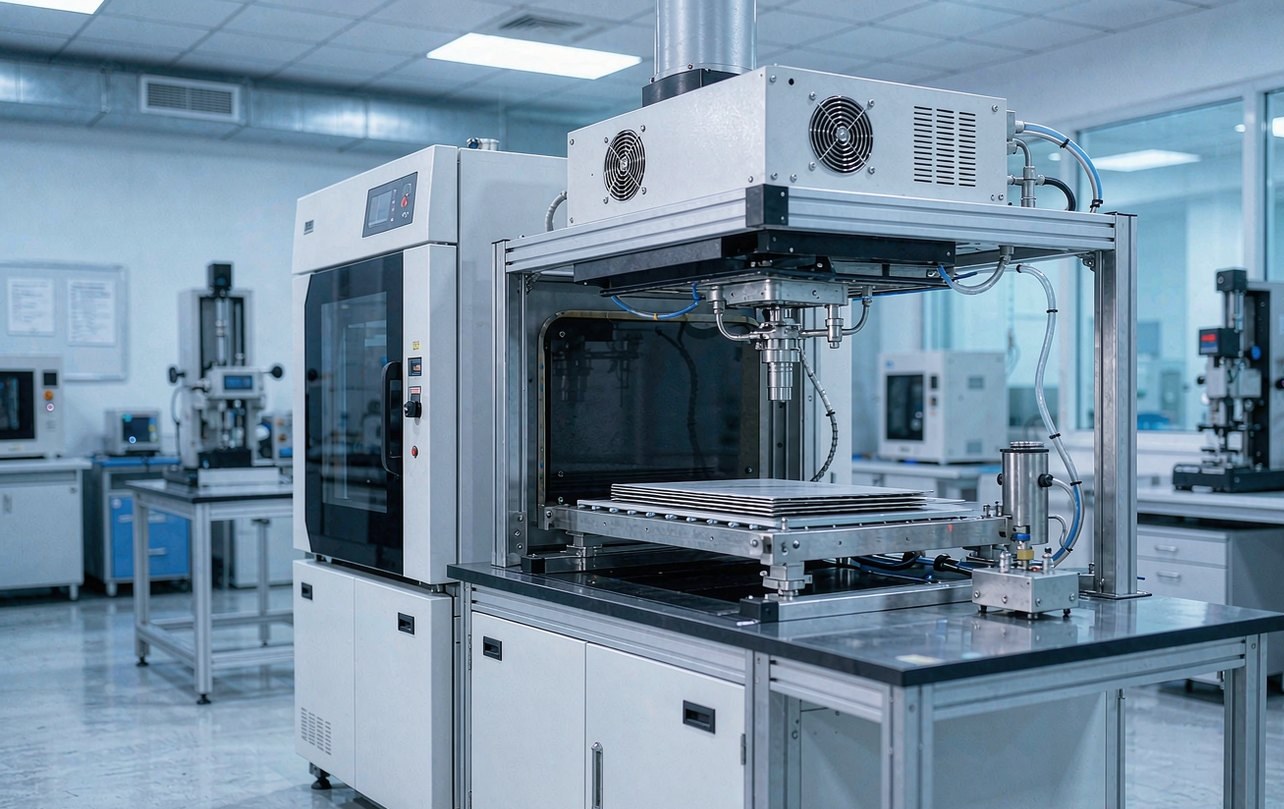
Accelerated ageing equipment is unavoidable in formulation development
Accelerated ageing reproduces years of natural exposure in the laboratory under controlled spectrum, temperature and humidity. It does not claim to replicate outdoor performance exactly. What it provides is a comparable, reproducible, quantifiable ranking between formulations.
| Test type | Common standards | Core measurement | Application |
|---|---|---|---|
| Xenon arc weathering | ISO 4892-2 / ASTM G155 / EN 14836 | ΔE, tensile strength retention, powdering and cracking | Primary method for sports turf procurement |
| Fluorescent UV ageing | ASTM G154 (UV-A / UV-B) / GB/T 16422.3 | Colour fastness change, tensile retention | Fast screening of UV-resistant formulations |
| Artificial climate ageing | DIN 53384 | Performance decay under combined climate load | Frequently specified by European customers |
| Textile colour fastness | AATCC 16.3 | Light fastness grade | Qualifying the colour masterbatch supplier |
| Mechanical properties | ASTM D5034 | Breaking strength, elongation, retention ratio | Required in all scenarios |
| Abrasion resistance | ISO 5470-1 / Martindale | Abrasion loss | High-wear zones such as sports pitches |
| Flame retardancy | GB 8624 / EN 13501-1 / SBI / cone calorimetry | Burning grade, HRR, char yield, smoke toxicity | Mandatory for public buildings and export |
| Restricted substances | RoHS / REACH / halogen screen / IEC 62321 | Br and Cl totals, SVHC screening | Mandatory for export |
| Microscopic analysis | SEM / FTIR | Crack morphology, chemical bond stability | Failure analysis for complaints |
02Industry Acceptance Criteria
Tensile retention ≥80%
Mechanical
Mean breaking strength after ageing divided by mean breaking strength before ageing. This is the core durability metric and the industry-wide gate is 80%. A good formulation should retain clear headroom above it.
Colour difference ΔE
Appearance
Change in colour must stay within the tolerance the product defines. Buyer definitions vary widely, so agree the value in the contract or specification before testing begins.
No powdering or cracking
Appearance
No visible chalking, cracking, fading or distortion at the end of the ageing cycle. These are the leading indicators of the mechanical failure that follows.
Elongation must not collapse
Mechanical
Elongation reflects fibre suppleness. A sharp drop means embrittlement, which in service produces abrupt breakage rather than a gradual decline in breaking strength.
Flame grade and smoke toxicity
Safety
Under GB 8624-2012 a formulation can meet the burning grade and still fail on smoke toxicity. CO ≤100 ppm and HCN ≤20 ppm must both be satisfied.
Four-element halogen screen
Compliance
Cl ≤900 ppm, Br ≤900 ppm, Cl+Br ≤1500 ppm. Note again that RoHS compliance does not equal halogen compliance.
Frequently overlooked: beyond mechanical and appearance criteria, many buyers also assess colourant migration and exudation after ageing, and whether the additive package affects spinnability and bending set. Fold these into the initial trial so they do not surface as a production problem later.
03Using Accelerated Ageing Data Correctly
Buyers frequently receive a laboratory report and still cannot judge service life. The reason is that no mapping has been established between the accelerated result and the target life. The defensible approach:
- Define the reference climate. Select a representative climate zone for the target market — high-UV, temperate, or extreme arid or coastal.
- Set irradiation levels. Apply the specified standard with several dose points, commonly 3000, 5000 and 8000 MJ/m².
- Plot performance against exposure. Sample at multiple timepoints and plot tensile retention and ΔE against cumulative irradiation, rather than reading only the endpoint.
- Identify the failure knee. Use the irradiation at which retention falls to 80%, or ΔE exceeds tolerance, as that formulation’s life marker.
- Compare in parallel. Test your candidates against a competitor product in the same batch. The relative ranking is usually more actionable than an absolute year figure.
On converting hours of xenon exposure into years of natural weathering: such factors vary widely with light source, wavelength and humidity control and should be treated as rough reference only, never as the basis of a customer-facing commitment. The rigorous method is multi-point sampling to build the mapping, cross-checked against outdoor exposure data.
03What Tiangang Supports
| Stage | Tiangang support |
|---|---|
| Formulation design | Candidate formulations and dosing ranges based on resin system, filler loading, climate zone and target life |
| Trial compounding | Additive samples and masterbatch compounds to support production trials under your existing process |
| Data review | Interpretation of third-party test reports and identification of optimisation opportunities, whether structural selection or dosage adjustment |
| Failure analysis | SEM and FTIR-level root-cause guidance for complaints or unexpected ageing behaviour |
| Compliance documentation | RoHS / REACH / TSCA documentation to support export customers’ file requirements |
| Field validation | 38 months of greenhouse field data from agricultural film; the methodology transfers directly to long-term turf weathering validation |
Our recommendation: move your acceptance standard forward to the formulation screening stage. Define the target standard (EN 14836, GB 8624 or your own criteria) at trial stage, run graded ageing against it, and select the formulation on data rather than validating after production has begun.
04Summary
Weathering performance is the outcome of formulation and process together; any missing link negates the rest. Tiangang supplies not merely a set of additives but the support path from formulation design through to data verification — so that a service-life claim becomes a fact that a third-party report can substantiate.
Light Stabilizer for Plastics
Light Stabilizer for Coatings
