Grass Fibre Photo-Oxidation and Formulation Design
Topic 1Grass Fibre Photo-Oxidation and Formulation Design
Fading, embrittlement and powdering look like a quality defect. They are the visible end of a chain reaction. Reading that chain is what gives formulation design a direction, instead of an additive loading trial-and-error loop.
01Step One: Identify Where Ageing Occurs
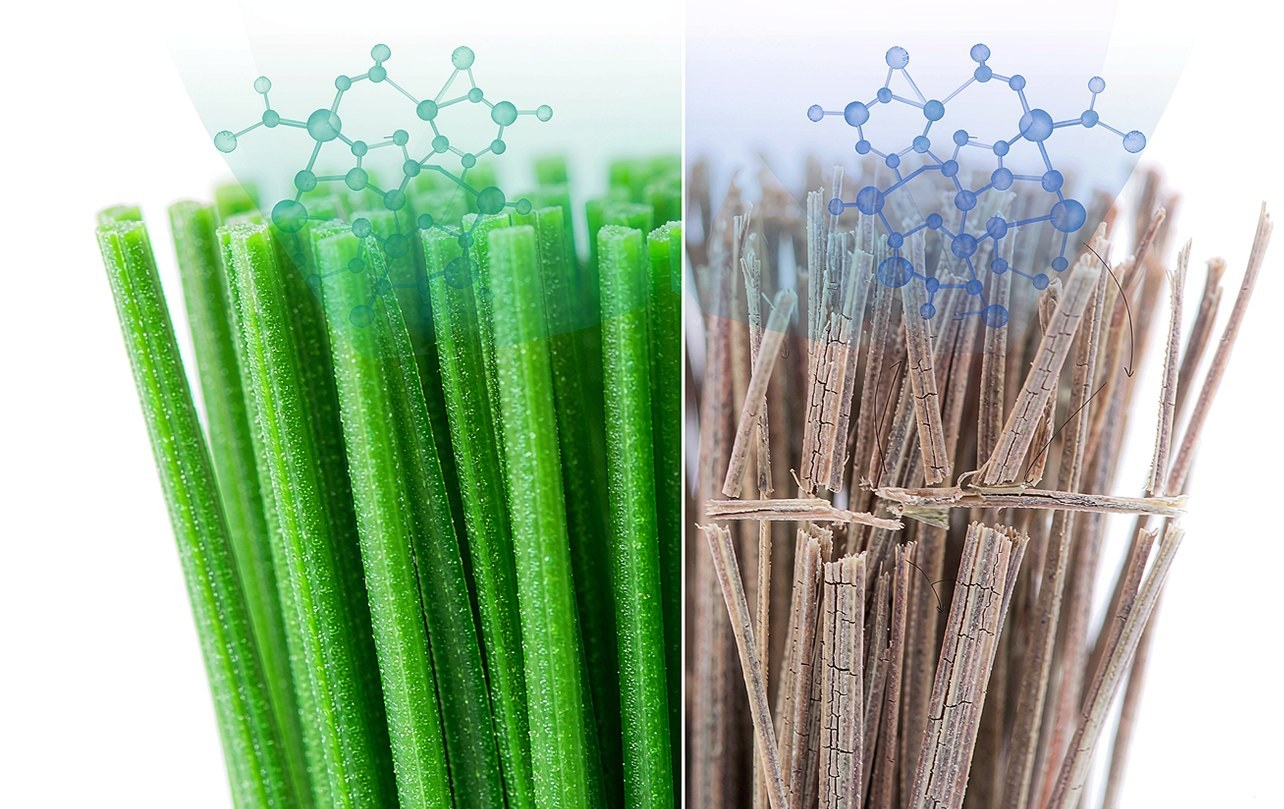
The complete photo-oxidation cascade has four stages, and a compounded system intercepts each one in turn:
| Stage | Chemical process | Counter-measure | Product family |
|---|---|---|---|
| 1. Initiation | UV-B cleaves PE / PP backbones, forming alkyl macroradicals R· | Absorb the photons and reduce initiation efficiency | UV-326 / UV-327 / UV-328 / UV-329 |
| 2. Propagation | R· + O2 → ROO·, an autocatalytic chain | Scavenge radicals and terminate the chain | HS-944 / BW-10LD / XT-8 (HALS) |
| 3. Degradation | ROO· → ROOH; molecular weight falls, material embrittles | Decompose hydroperoxides before they fragment further | AO-1010 / AO-B215 (hindered phenol) |
| 4. Catalysis | ROOH decomposition yields acidic products that accelerate neighbouring ageing | Chelate transition metals, suppress catalytic oxidation | AO-168 / AO-DSTDP (phosphite) |
02Step Two: Map the Acid Loads in Your System
HALS performance depends heavily on whether it is consumed by acidic species. Turf fibre formulations commonly contain four such sources:
- Flame retardants. Brominated grades thermally or photolytically release HBr / Br−; phosphorus grades generate phosphoric degradation products.
- Rubber infill. Vulcanisation residues and stearic acid are the primary acid load in filled systems.
- Colour concentrates and fillers. Some masterbatches contain acidic co-additives that slowly consume stabiliser at the fibre surface.
- Service environment. Acid rain (locally below pH 4.5), chlorine-based cleaning agents (NaClO), and sustained warmth and humidity.
Once identified there are two responses: change the structure by selecting an N-CH3 or N-OR backbone that is intrinsically less reactive, or change the route entirely by removing the acid source at origin with a NOR flame retardant such as FR-810A. The first suits an existing retardant system; the second suits a new project where the specification is still open.
03Step Three: Select the HALS Structure
| Structure | Representative product | Basicity | Acid resistance | Where it fits |
|---|---|---|---|---|
| N-H (classical) | HS-944 | Higher | Low | Pure systems without retardant or filler; largest historical market share |
| N-CH3 (ester) | BW-10LD (622) / HS-950 | Low | Moderate to good | Filled turf; formulations containing flame retardants |
| N-OR (NOR) | XT-8 (high MW) / HS-112 (liquid) | Very low | Excellent | Acid rain, high sulfur, export-compliance scenarios |
| Compounded package | HS-962 / HS-788 | Adjustable | Adjustable | Customers avoiding in-house blend development |
| Masterbatch grade | MB6250PP20 / MB6251PP20 | — | — | Where dispersion uniformity is critical, to prevent blotchy ageing |
04Step Four: Establish Dosage and Verify
Industry reference loadings are HALS 4–10‰, antioxidant 1–2‰, UV absorber 0.3–0.5% relative to resin. The optimum, however, is determined by accelerated ageing data, not by copying a reference figure.
| Step | What to do | Acceptance criterion |
|---|---|---|
| 1. Formulation design | Define resin system, filler loading, flame retardancy requirement, target life | Two or three candidate formulations |
| 2. Specimen preparation | Extrude or injection-mould under actual process conditions; hold draw ratio and cooling constant | Representative specimens |
| 3. Accelerated ageing | ISO 4892-2 / ASTM G154 / ASTM G155 xenon or UV exposure | Irradiation dose matched to target service life |
| 4. Mechanical testing | ASTM D5034 for breaking strength and elongation before and after | Tensile retention ≥80% is the industry gate |
| 5. Appearance assessment | Measure ΔE and inspect for powdering, cracking and fading | ΔE within the agreed tolerance |
04Summary: An Actionable Selection Logic
- No retardant, no filler → HS-944 + UV-328 + AO-1010/AO-168, optimised for cost.
- Filled turf or a system containing retardant → BW-10LD (622) + UV-328 + AO-1010/AO-168, prioritising acid tolerance.
- European or North American export with flame retardancy → FR-810A + HS-944 + AO-1010/AO-168, one integrated answer.
- Acid-rain zone, high sulfur, or an extended-life specification → XT-8 or HS-962, or masterbatch grades.
- Where formulation capability is limited and speed matters → HS-788 or HS-962 packages.
Light Stabilizer for Plastics
Light Stabilizer for Coatings
